


Key Takeaways
Wi-Fi gets its first formal AI standardization effort. The IEEE 802.11 Working Group and the 802 LAN/MAN Standards Committee (LMSC) approved the formation of an AI Offload Study Group, which will develop a standard amendment enabling Wi-Fi access points to serve as edge AI compute nodes. This marks AI’s official entry into the Wi-Fi standards pipeline. Organizations building enterprise Wi-Fi infrastructure should begin tracking this effort now, as it could fundamentally reshape access point capabilities and network architecture within the next standards cycle.
Integrated mmWave (802.11bq) locks in its physical-layer packet format. The task group agreed on the structure of the Integrated mmWave PPDU (PHY Protocol Data Unit), the fundamental packet format for 60 GHz Wi-Fi transmission, adopting a design deliberately similar to existing sub-7 GHz Wi-Fi. MAC scheduling discussions remain active, with many contributions exploring approaches for both periodic and on-demand service periods, though motions on scheduling frameworks have been deferred. The task group continues to review technical contributions as it populates its Specification Framework Document.
Wi-Fi 8 (802.11bn) is 60% through comment resolution, but Draft 2.0 slips. The task group has resolved approximately 60% of the technical comments on its first complete draft. Draft 2.0 has slipped from May to July 2026, though the May 2028 ratification target remains intact.
Wi-Fi 9 discussions continue with broadening participation. The Wireless Next Generation (WNG) Standing Committee continued early discussions about the generation that follows Wi-Fi 8, with six next-generation contributions in the March 2026 document cycle covering performance targets, use cases, and standards methodology. A formal Study Group is expected to form at the July 2026 plenary.
Overview
The March 2026 IEEE 802.11 document cycle, including publicly available materials associated with the March 8–13 plenary session and the preceding TGbn MAC ad hoc, reflects significant movement across three major Wi-Fi initiatives. As our January readout previewed, three major Wi-Fi initiatives converged during this cycle: Wi-Fi 8 continued its march through comment resolution, Integrated mmWave reached important architectural decisions, and the Wireless Next Generation committee built further momentum toward Wi-Fi 9.
But the most significant development in this cycle may prove to be the formal approval of an AI Offload Study Group. The published contribution and motion records show Qualcomm as the primary proponent, whose contributions and motions shaped the proposal. The approval signals that the Working Group views AI not as an abstract future consideration but as a concrete, near-term engineering problem requiring standardized solutions.
This readout covers the AI Offload Study Group and what it means for the direction of Wi-Fi, the progress in Integrated mmWave, the state of Wi-Fi 8 as it approaches its next major draft, and the accelerating Wi-Fi 9 conversation.
AI Offload: Wi-Fi’s First Step Toward Becoming an AI Platform
Artificial intelligence workloads have traditionally been handled by cloud servers or increasingly powerful on-device processors. But a growing class of applications demands something in between. AI-powered smart glasses that need to interpret live video, robotic systems running vision-language-action models, and enterprise AI assistants all require edge compute resources close enough to the device to deliver sub-20-millisecond response times, but powerful enough to run models that would drain a mobile device’s battery in minutes.
What Was Approved
The newly approved AI Offload Study Group will develop a Project Authorization Request (PAR) for a standard amendment that enables Wi-Fi access points and other Wi-Fi-enabled edge devices to accept and execute compute-intensive AI inference tasks offloaded from client devices. In practical terms, this would turn a Wi-Fi access point into a shared AI co-processor. A laptop sends a complex inference task to the access point, which processes it locally and returns the result, all without the latency penalty of routing through the cloud.
The scope of the AI Offload proposal is notable given the broader landscape of company positions on AI standardization. The published contribution record shows Qualcomm as the most active proponent of bringing AI into the 802.11 standards process, with limited comparable activity from other major device manufacturers in the document record. That contrast could shape which companies define the architecture of AI-capable Wi-Fi networks as the Study Group develops its PAR.
AI Offload in Context
The AI Offload Study Group sits within a broader wave of AI-related activity inside IEEE 802.11. As our January readout noted, the existing AI/ML Standing Committee has been exploring use cases such as AI-enhanced roaming, deep reinforcement learning for channel access, and AI-driven multi-AP coordination. Those are all cases where AI improves Wi-Fi itself. The AI Offload effort inverts this relationship. Rather than using AI to make Wi-Fi better, it uses Wi-Fi to make AI better by positioning the network as an AI execution platform.
Per the published IEEE 802.11 session report, the group begins formal operations at the May 2026 interim in Antwerp.
Why AI Traffic Is Different
A published Huawei contribution to the WNG Standing Committee provided useful context for understanding why AI workloads pose unique challenges for Wi-Fi networks. The traditional 9:1 download-to-upload traffic ratio that has defined Wi-Fi for decades is breaking down. AI interactions, especially voice, video, and multimodal agents, require continuous data to be sent to the cloud or edge. Sending a high-resolution image for AI processing or streaming live video to an AI assistant can spike uplink usage to 25 Mbps per device, a pattern that conventional Wi-Fi networks were not designed to handle efficiently.
Unlike viral videos that can be cached locally by a content delivery network, every generative AI response is unique, preventing traditional bandwidth-saving techniques from working. By 2032, AI is projected to account for nearly 20% of all internet traffic. These traffic characteristics (uplink-heavy, latency-sensitive, and uncacheable) make a compelling case for embedding AI awareness directly into the Wi-Fi standard.
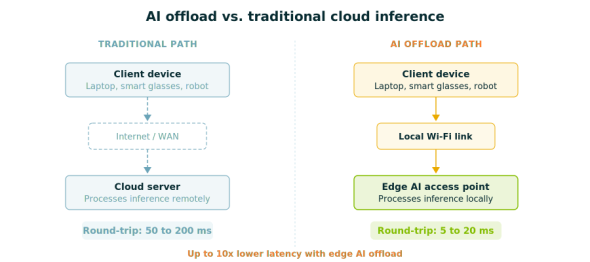
Figure 1. AI offload routes inference tasks to a local edge-capable access point instead of the cloud, reducing round-trip latency by up to 10x.
Integrated mmWave: From Architecture Debate to Packet Format
Our January readout covered the Integrated mmWave (802.11bq) project’s architectural fault line, specifically the debate over whether 60 GHz links should be prohibited from transmitting their own beacon frames or allowed to operate with some degree of independence from the sub-7 GHz control channel. That debate remains open, but published records from the March 2026 cycle show the task group making tangible progress on another foundational question: how should data packets look like when transmitted over the 60 GHz band?
The PPDU Format Takes Shape
Every Wi-Fi transmission is wrapped in a structure called a PPDU (PHY Protocol Data Unit). Think of it as an envelope that carries your data. The envelope has a standard set of fields at the beginning, called a preamble, that help the receiving device detect the signal, estimate channel conditions, and figure out how to decode what follows. These fields include training sequences (short and long patterns that help the receiver synchronize and calibrate), signaling fields (which tell the receiver the modulation scheme, coding rate, and packet length), and then the actual data payload.
According to published motion records, the task group passed motions (formal votes on specific technical decisions) in the March 2026 cycle finalizing the basic structure of the Integrated mmWave PPDU. The agreed format deliberately mirrors the existing sub-7 GHz Wi-Fi preamble structure. It uses analogous training sequences (called M-STF and M-LTF for the initial synchronization, then IMMW-STF and IMMW-LTF for the mmWave-specific portion) and signaling fields, while remaining flexible enough to accommodate the unique propagation characteristics of 60 GHz spectrum.
This design choice matters commercially. By keeping the mmWave packet format similar to what chipmakers already implement for sub-7 GHz Wi-Fi, the group is lowering the barrier to adding 60 GHz capability into mainstream Wi-Fi chips. This is an important lesson from WiGig (802.11ad/ay), the previous 60 GHz Wi-Fi effort, which struggled with market adoption partly because its design diverged significantly from traditional Wi-Fi, forcing chipmakers to treat it as a separate product rather than an integrated feature.
MAC Scheduling Advances
Beyond the packet format, the group made progress on how devices will coordinate when they use the mmWave link. The 60 GHz band is not always-on like traditional Wi-Fi. Instead, devices need a way to request or schedule windows of mmWave access, since the high-frequency link consumes more power and requires precise beam alignment between the access point and the device.
Published contributions address this with two broad approaches under discussion. For predictable, recurring needs (like a VR headset that needs a burst of bandwidth every 10 milliseconds), contributions have proposed leveraging Target Wake Time (TWT), already familiar from Wi-Fi 6 and 7, which lets devices pre-schedule regular mmWave access windows. For unpredictable, on-demand needs (like a laptop that suddenly needs to transfer a large file), contributions have proposed an ICF/ICR (Initial Control Frame / Initial Control Response) framework, where the device requests a mmWave session through the sub-7 GHz link and the access point grants it in real time. Formal motions on these scheduling frameworks have been deferred, but the volume and breadth of contributions reflect healthy and active discussion.
The task group continues populating its Specification Framework Document (SFD), which consolidates these decisions into a structured outline of the full specification. Technical contributions on beam establishment (how a device and access point align their directional antennas) and service period management continue to be reviewed.
Wi-Fi 8: Steady Progress Toward Draft 2.0
Wi-Fi standards go through a multi-year refinement cycle. After engineers write features into a draft specification, it goes out for a formal working group letter ballot where every voting member approves/disapproves the draft specification and can submit detailed technical comments. The task group resolves each comment and produces the next draft. Higher draft numbers mean the specification is closer to final and the remaining issues increasingly narrow. Our January readout covered this process in detail for Wi-Fi 8, including how the first letter ballot on Draft 1.0 generated over 8,000 comments and how Draft 1.3 was approved in January. This section picks up where that left off.
The task group has now resolved approximately 60% of those comments, and Draft 1.4 was authorized in the March 2026 cycle. The core features of Wi-Fi 8 are increasingly locked down; the remaining 40% tend to involve edge cases and interactions between features rather than fundamental design questions. However, the volume has pushed Draft 2.0 (the milestone that triggers a new round of voting) from May to July 2026. For context, resolving Wi-Fi 7’s 4,000 comments took approximately one year, so the pace on Wi-Fi 8’s 8,000+ comments is broadly consistent with precedent even if the sheer volume demands more calendar time.
Topics addressed in recent comment resolutions include Multi-Access Point Coordination (enabling multiple access points to work together to serve clients), Coordinated Beamforming (aligning antenna patterns across access points to reduce interference), and Non-Primary Channel Access (allowing devices to transmit on additional channels when their primary is busy). The published document list includes more than 100 comment resolution submissions. The May 2028 ratification target remains intact.
| Milestone | Target |
| Draft 1.4 (current) | March 2026 |
| Draft 2.0 (next recirculation ballot) | July 2026 (slipped from May) |
| Draft 3.0 (continued refinement) | January 2027 |
| Standards Association ballot (D4.0) | May 2027 |
| Final working group approval | March 2028 |
| Publication as IEEE standard | May 2028 |
Wi-Fi 9: The Industry Debates What Comes Next
Our January readout described how the Wireless Next Generation (WNG) Standing Committee held its first discussions about what follows Wi-Fi 8. The March 2026 cycle continued with six additional next-generation contributions, broadening the conversation to include network equipment vendors and broadband operators alongside the chipmakers who led the January sessions.
Early Performance Targets
With 10+ Gbps fiber now rolling out to homes, several contributions argued that Wi-Fi needs to keep pace. Proposed targets included peak single-user throughput exceeding 10 Gbps, aggregate throughput above 30 Gbps across multiple links, and support for 200 or more active devices per access point. On latency, the focus shifted from averages to worst-case guarantees: 99th-percentile latency under 10 milliseconds for general traffic and sub-5 milliseconds for applications like haptic communication and real-time inference.
Use cases ranged from industrial robotics and mission-critical video to extended reality and multi-dwelling unit deployments. A recurring theme was the changing shape of Wi-Fi traffic: as AI-generated workloads grow and the traditional download-heavy traffic mix shifts toward more balanced uplink and downlink, contributors argued that uplink performance needs to become a first-class design priority. The proliferation of wearables, in-vehicle systems, and robots is also creating topologies that mix peer-to-peer and infrastructure links, requiring better coexistence between the two modes.
Deployment Concerns and How to Build the Standard
A published joint contribution from several broadband operators pushed back on the pace and approach of the discussion. They argued that the Best Effort access category, which carries most Wi-Fi traffic today, needs latency improvements for congested environments like apartment buildings, and questioned whether the current four-year amendment cycle is realistic given that operators are still running trials on Wi-Fi 7 in 2026. Separately, one contribution challenged the standard-setting methodology itself, pointing out that Wi-Fi 8’s defining themes in 2022 (XR and the metaverse) bear little resemblance to the AI-driven narrative of 2026. The proposed alternative: rather than picking a theme and working top-down, start from a gap analysis of the current standard, fix known shortcomings, and let the narrative emerge from the engineering work.
These discussions are still early-stage. A formal Study Group is expected to form at the July 2026 plenary, at which point the scope and direction will begin to solidify.
Timeline Expectations
Wi-Fi standards follow a predictable lifecycle. First, a Study Group forms to investigate whether a new standard is needed and what it should cover. If the answer is yes, a formal Project Authorization Request (PAR) is approved, and a Task Group begins the multi-year work of writing the specification. The historical cadence for major Wi-Fi generations has been remarkably consistent, with each generation following roughly the same tempo.
Based on timeline data compiled in published WNG contributions tracking the last four generations, the pattern looks like this.
| Generation | Study Group Formed | Project Authorized | Spec Work Began | Final Approval |
| Wi-Fi 5 (802.11ac) | May 2007 | Sep 2008 | Nov 2008 | Nov 2013 |
| Wi-Fi 6 (802.11ax) | May 2013 | Mar 2014 | May 2014 | Sep 2020 |
| Wi-Fi 7 (802.11be) | May 2018 | Mar 2019 | May 2019 | Mar 2024 |
| Wi-Fi 8 (802.11bn) | Sep 2022 | Sep 2023 | Nov 2023 | Mar 2028 (target) |
A Study Group forming in July 2026, as all major contributors now expect, would suggest a task group starting around mid-2027, with a specification completing around 2032. Several contributors noted that unlike previous generations, there are no obvious mature features from cellular to adopt, nor significant new sub-7 GHz spectrum to exploit. Others cautioned against rushing into feature proposals, emphasizing the need to first understand market requirements thoroughly. That makes the coming months of WNG discussion particularly consequential for shaping what the next generation of Wi-Fi ultimately becomes.
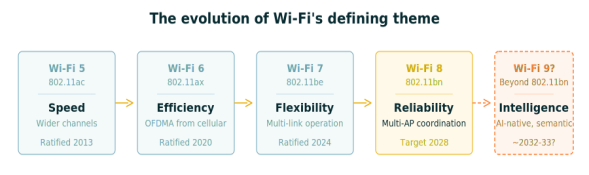
Figure 2. Each Wi-Fi generation has shifted the core problem the standard solves, from speed to efficiency to flexibility to reliability. The theme shown for Wi-Fi 9 is illustrative; the actual direction is still being determined.
What’s Next
The next major milestone is the May 2026 IEEE 802 Wireless Interim in Antwerp, Belgium (May 10–15), preceded by a TGbn MAC ad-hoc meeting in Antwerp in May 6-8.
AI Offload. The Study Group begins formal operations. This is the earliest window to influence the scope and direction of Wi-Fi’s AI standardization effort.
Integrated mmWave. Technical contributions will continue on beam establishment and scheduling refinements. The broader question of how much independence 60 GHz links should have remains open.
Wi-Fi 8. Comment resolution continues toward Draft 2.0 in July. The Antwerp MAC ad-hoc in May 6-8 will help keep the revised timeline on track.
Wi-Fi 9. WNG discussions will continue building toward a formal Study Group at the July 2026 plenary. The first half of 2026 is expected to remain focused on market requirements, with specific feature proposals deferred to H2.