

Key Takeaways from RAN Plenary #111, Fukuoka
Way forward agreed on how much spectrum 6G devices can use at the key 7 GHz band — A dispute over how wide a block of radio spectrum 6G devices should be able to use in a single transmission was resolved at the plenary level. The agreed way forward (RP-260798) allows 6G to support both 200 MHz and 400 MHz channel widths on the downlink (network to device), with 400 MHz being optional for the device. On the uplink (device to network), the working groups are tasked to study support at a maximum of 200 MHz, with 400 MHz uplink deferred to a future release. This resolution cancelled a potential formal vote and clears the path for the working groups to move forward with 6G radio design at the frequency band most critical to 6G deployment.
Plenary assigns ownership of AI/ML use cases across working groups — Artificial Intelligence and Machine Learning (AI/ML) capabilities for 6G touch multiple working groups at the same time, creating a risk of duplicated or conflicting work. The plenary sorted out which groups will lead and which will play a supporting role for each category of AI/ML use case. Physical-layer measurement prediction goes to RAN WG1, mobility event prediction to RAN WG2, and AI-based radio resource management to RAN WG4, with cross-group dependencies explicitly mapped. The plenary will reassess this coordination at RAN#113 in September 2026.
Overview
Every quarter, 3GPP holds plenary meetings where senior representatives from the world’s major wireless companies make high-level decisions about the direction of cellular standards. These plenaries sit above the working groups, which do the detailed technical work between meetings. When working groups cannot reach agreement on a topic, or when a decision affects multiple groups, it escalates to the plenary for resolution.
The March 2026 plenaries (designated TSGs#111) took place in Fukuoka, Japan, from March 9–13, 2026. The RAN Plenary (RAN#111, March 9–12) handles decisions related to the radio interface, meaning how devices communicate over the air with cell towers. The SA and CT Plenaries, which cover the core network and service architecture, met concurrently.
These meetings arrived at a significant moment. The 6G Radio study, formally launched in August 2025 as part of 3GPP Release 20, is now approximately one-third complete against its May 2027 target. The preceding working group meetings in Gothenburg and Goa (February 9–13, 2026) had produced substantial technical progress, including a finalized list of candidates for improving 6G uplink signal quality and the launch of a study on redesigning how base stations configure device behavior. But they also left an unresolved dispute: one of the working groups had declared an agreement on how much spectrum 6G devices could use at the 7 GHz band, and that agreement was challenged, sending the question to the plenary.
The Fukuoka plenary produced two notable outcomes. The first was a way forward on channel bandwidth, resolving the dispute and avoiding a formal vote. The second was a coordination framework for AI/ML use cases, sorting out which working groups will lead which areas of study. This readout covers both.
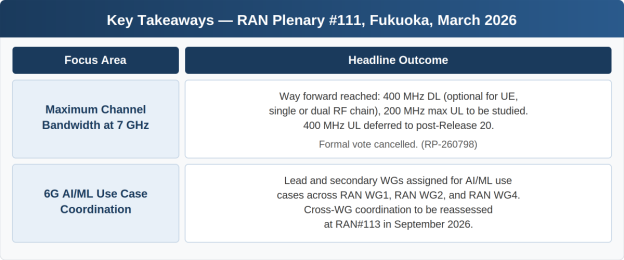
Figure 1: Key Takeaways — RAN Plenary #111, Fukuoka, March 2026
The 7 GHz Channel Bandwidth Way Forward
When you stream video or make a call on your phone, the device is transmitting and receiving data over a specific slice of radio spectrum. Channel bandwidth refers to how wide that slice is. A wider channel lets the device move more data at once, similar to how a wider highway can carry more traffic. But wider channels also require more complex and power-hungry hardware in the device, and they consume more of the limited spectrum available to operators. Choosing the right channel bandwidth is one of the most consequential decisions in designing any new generation of cellular technology.
For 6G, the 7 GHz band (the spectrum around 7.125 GHz) is expected to be a primary deployment frequency. Getting the channel bandwidth right at this band has downstream effects on everything from device cost to network coverage to the pace of the overall standardization effort. It is the kind of foundational parameter that many other design decisions depend on.
The dispute that arrived in Fukuoka had been building over previous meetings. At RAN WG4’s 118th meeting in Gothenburg, Sweden (February 9–13, 2026), the working group that handles radio performance and device testing requirements attempted to settle the question. The RAN4 chair declared a working agreement (R4-2602322) on maximum channel bandwidth for both the downlink (data sent from the network to the device) and the uplink (data sent from the device back to the network) at 7 GHz.
The agreement found that from the network side, supporting a 400 MHz channel on a single carrier was feasible and preferable. But from the device side, the picture was more complicated: while 400 MHz was technically achievable, most device chipset vendors preferred 200 MHz due to the hardware complexity and power consumption involved. The group also could not reach consensus on whether there were meaningful practical differences between using a single wide 400 MHz carrier versus combining two 200 MHz carriers together (an approach called carrier aggregation). On the uplink, 200 MHz was taken as the device baseline, with 400 MHz considered infeasible by the majority of device vendors.
This working agreement was challenged at the plenary level, which meant the plenary either had to confirm the agreement or find an alternative. A formal vote was a possibility, which is a rare and significant procedural step in 3GPP. The organization strongly prefers consensus-based decision-making, and a formal vote on a parameter of this importance would have forced companies to take public positions that could harden disagreements rather than resolve them.
After extensive debate, the plenary reached a way forward and the formal vote was cancelled. The agreed resolution, captured in the formally approved document RP-260798, sets the following framework. On the downlink, 6G specifications will support channel bandwidths of 200 MHz and 400 MHz, along with other values in between depending on what operators need for their spectrum holdings. Support for 400 MHz on the downlink is optional for the device and can be implemented using either a single radio frequency (RF) processing chain or two RF chains working together, with both approaches presenting the same interface to the rest of the system. The specification will also ensure that from the device’s perspective, a single control message schedules a single data transmission spanning the entire channel bandwidth, keeping the complexity manageable regardless of the underlying hardware approach.
On the uplink, the way forward tasks the working groups to study support of data and sounding transmissions in a maximum channel bandwidth of 200 MHz, with the ability to sound (measure) all parts of the downlink bandwidth over time. The question of whether 6G devices should support 400 MHz on the uplink was explicitly deferred to beyond Release 20, based on future contributions. This reflects the practical consensus that current and near-term device hardware cannot support 400 MHz uplink transmissions.
The significance of this resolution extends beyond the specific numbers. By establishing what the specification must support, what is optional, and what is deferred, the plenary gave the working groups a clear framework within which to conduct the rest of the 6G radio study. Without this resolution, design decisions in multiple working groups that depend on knowing the bandwidth limits would have remained blocked.
AI/ML Use Case Coordination Across Working Groups
Artificial Intelligence and Machine Learning (AI/ML) are being explored as tools to make 6G networks smarter. Rather than relying solely on fixed rules, AI/ML could allow networks and devices to predict and adapt to changing conditions, potentially improving handover reliability, coverage, and resource efficiency. These capabilities are a growing part of the 6G Radio study.
The challenge is organizational. 3GPP’s RAN (Radio Access Network) work is divided across five working groups, each responsible for a different layer of the radio interface. RAN WG1 handles the physical layer (how signals are actually transmitted), RAN WG2 handles higher-layer protocols (how the device and network coordinate), RAN WG3 handles network architecture and interfaces between base stations, RAN WG4 handles radio performance requirements and base station testing, and RAN WG5 handles terminal testing. An AI/ML capability like predictive handover might need new signal processing in RAN WG1, new signaling protocols in RAN WG2, and new performance requirements in RAN WG4, all at the same time. Without clear ownership, the same capability could end up being studied by multiple groups with incompatible assumptions.
The RAN Plenary addressed this by collecting the AI/ML use cases identified by each working group and sorting them into a coordination framework with explicit lead and supporting roles.
The framework assigns ownership along functional lines. RAN WG1 will lead studies on using AI/ML to predict physical-layer measurement values (called L1 measurements) to support mobility, meaning predicting the signal quality a device would see from nearby cells before it actually measures them. This work impacts RAN WG2 and RAN WG4, which will contribute as secondary groups. RAN WG2 will lead studies on using AI/ML to predict when mobility will be triggered, allowing the network to begin preparing handovers proactively rather than waiting for a threshold to be crossed. This impacts both RAN WG1 and RAN WG4. For predictions based on higher-layer measurements (called L3 measurements), the ownership is split depending on the scenario: some use cases will be led by RAN WG2, others by RAN WG4. All AI-RRM (AI-based Radio Resource Management) use cases, which cover applications like dynamically adapting how often a device performs measurements or reducing the interruptions of data transmission required for those measurements, will be led by RAN WG4, with impact on RAN WG2 and/or RAN WG1 depending on the specific use case.
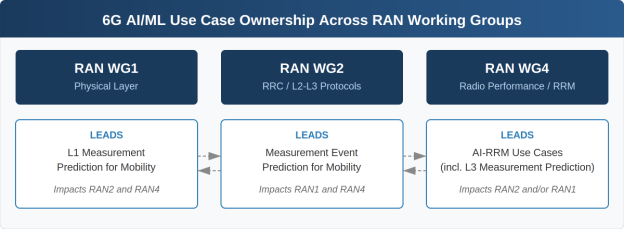
Figure 2: 6G AI/ML Use Case Ownership Across RAN Working Groups
The plenary set a checkpoint for this coordination: RAN#113 in September 2026 will reassess how the work is progressing and whether the ownership assignments need adjustment. This gives the working groups two RAN meeting cycles (RAN WGs meeting in April, May, and August) to produce initial results under the new framework.
What’s Next
The next milestone is the RAN working group interim meetings in April and May 2026, followed by the TSG plenaries (TSGs#112) in June in Singapore.
Working groups begin designing within the bandwidth framework. With the way forward on channel bandwidth approved (RP-260798), the working groups can move ahead on 6G radio design at the 7 GHz band. The key questions that follow are practical: how will the optional 400 MHz downlink behave across single and dual RF chain implementations? What restrictions on resource mapping are needed around synchronization signals and RF chain boundaries? And in the uplink, what are the design implications of supporting data and sounding transmissions at 200 MHz? These details will be worked through in the coming RAN WG sessions.
AI/ML use case studies begin under assigned ownership. The April meetings will be the first time RAN WG1, RAN WG2, and RAN WG4 study their assigned AI/ML use cases under the plenary’s coordination framework. The September 2026 reassessment at RAN#113 gives the work a defined horizon, and early progress in the April, May, and August sessions will shape whether the current ownership assignments hold or need adjustment.
The 6G Radio study is now roughly one-third complete against its May 2027 target. The Fukuoka plenary cleared a significant procedural obstacle on channel bandwidth and established coordination infrastructure for AI/ML. The working groups now carry both mandates into the next phase.