


Two hours of headsets, glasses-free 3D displays and one recurring question from colleagues – and the standards work that decides whether this content ever leaves the demo table.
On August 20, 2026, the Advanced Media Lab hosted Ofinno’s first Gaussian Splat Showcase, filled with virtual reality (VR) headsets, glasses-free 3D displays, a poster presentation, and a coding framework demo.
Ofinno’s summer intern, Muhammad Talha, presented the work from his ten weeks of research: an end-to-end Gaussian splat coding pipeline. He walked through the design, showed the pipeline running, and talked through what strains when you push Gaussian splat content through machinery originally designed for something else.
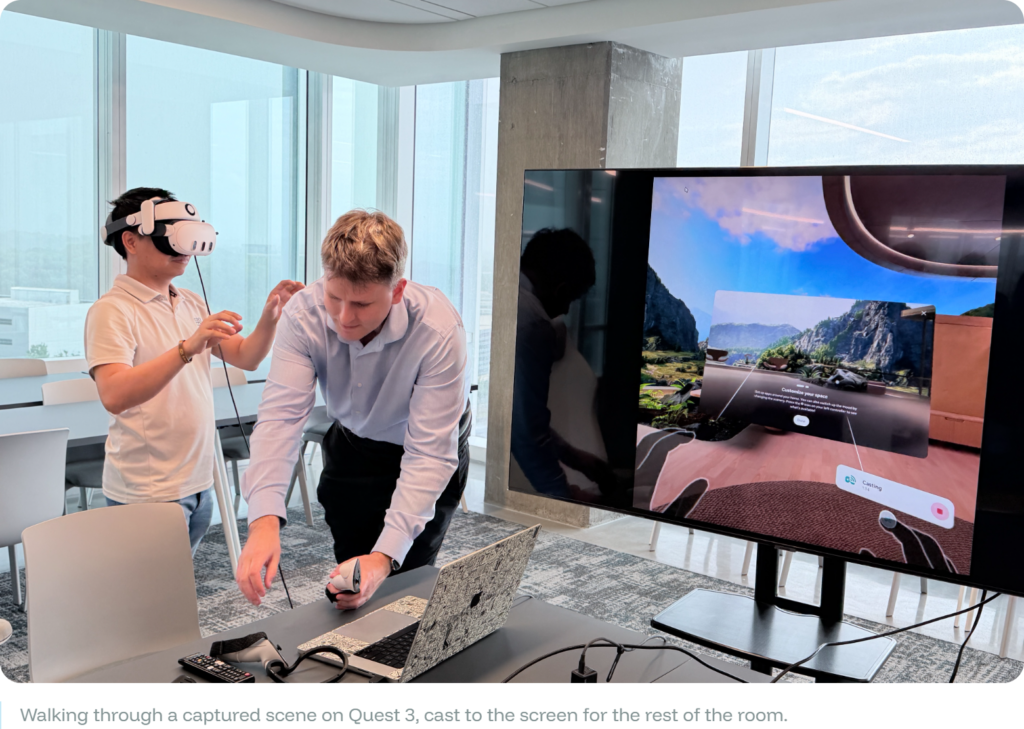
Then the room turned into a showcase. Ofinno’s Gaussian Splat experts set up several ways to meet the same technology from different angles: VR on Quest 3, running an application powered by Gracia AI, the closest thing to standing inside a captured scene, dynamic 4D Gaussian splat content included; AR experiences, dropping splat scenes into the room via the attendees’ own phones; a poster presentation on Gaussian splatting and the Gaussian splat data representation, with light field display demos on three Looking Glass Go displays, showing the splats in glasses-free 3D; and Gaussian splat coding demos, showcasing an end-to-end framework.

So, what is the splatting technique and its data representation, the Gaussian splat?
Start with the problem it solves. If you want a computer to show you a real place, such as a room, a statue, or a person, the traditional route is to rebuild it: start from a point cloud, reconstruct with a mesh of triangles, textures painted on top, lighting placed by hand. It works, but it is a great deal of work that can last days or months to make it photorealistic.
Gaussian splatting takes a different route. You capture photos or a video of a scene from many angles, and an optimization process fits millions of tiny, soft, translucent 3D blobs, known as Gaussians, to what the cameras saw. Each blob carries a position, a size and orientation (it can stretch into an ellipsoid, which is how you get crisp edges out of soft shapes), a transparency, and a color that shifts depending on where you view it from. This is what allows glossy and reflective surfaces to behave believably. The scene is simply fitted to the photographs and can be reconstructed in minutes or hours.
To draw a frame, those blobs are projected onto the screen and blended together. That projecting-and-blending step is the “splatting.” Because it is simple and highly parallel, it runs in real time on ordinary hardware, and it looks photographic in a way hand-built meshes have always struggled to match. Captured from real photos, photorealistic, real-time: that combination is why the technique went from a single research paper to being everywhere in about three years.
Two different things share the name
Here is where the terminology trips people up; it is worth pulling apart, because the distinction is the whole reason our lab is involved.

The nearest everyday analogy is playing video versus a video file. One is what your device does; the other is what has to travel across the network to reach it. Our industry has spent three decades standardizing the compression of 2D video. This is precisely why any video you click can play on any device you own almost instantly. For the compression of Gaussian splats, that work is just getting started.
Why compression is essential to wider adoption
Gaussian splat scenes are big. The per-splat appearance attributes, especially the view-dependent color terms that make the material look right, dominate the file and there are millions of splats in a single scene. Make the content dynamic (a 4D capture: a person moving, rather than a frozen statue) and all of that gets multiplied by the frame rate. A few seconds of volumetric video adds up fast.
So there are two problems we’re faced with, and they are really the same problem. One is size: nobody streams that much data per second. The other is interoperability: if every capture tool writes its own format, and every viewer reads a different one, none of this ever leaves the demo table. Standardized compression is what turns a striking research result into content that a phone in someone’s hand can receive and play.
MPEG, the standards body behind the video formats in essentially everything with a screen, has this squarely on its agenda. Gaussian splat coding is an active exploration, advancing along two tracks: near-term work that carries Gaussian splat content within the existing coding standards, and a longer-term exploration aimed at substantially higher coding efficiency, with a call for proposals expected in 2027 to bring the industry’s best tools into open competition. The format that emerges will shape how this kind of content is delivered for years.
What the Advanced Media Lab is doing about it
Ofinno’s Advanced Media Lab (AML) works on media compression standardization, including 2D video, and 3D content in its various forms. In practice, that means being in the room where the format gets decided. The AML team studies the content, proposes and implements coding tools, runs the experiments that show whether a tool actually earns the bits it costs, and contributes those results into the standardization process.
The first Splat Showcase was the visible half of that work: a room of headsets, glasses-free displays, and colleagues asking what they were looking at. The compression and interoperability questions behind it are the half that decides whether anyone outside the room ever gets to see it.