

At Ofinno, we spend every day working at the intersection of invention and intellectual property. Our researchers develop foundational technologies for 5G/6G, Wi-Fi, and media compression standards, and our patent attorneys work alongside them to translate those innovations into high-quality patents. It’s what we do — and it’s a process we believe more young people should have the chance to experience firsthand.
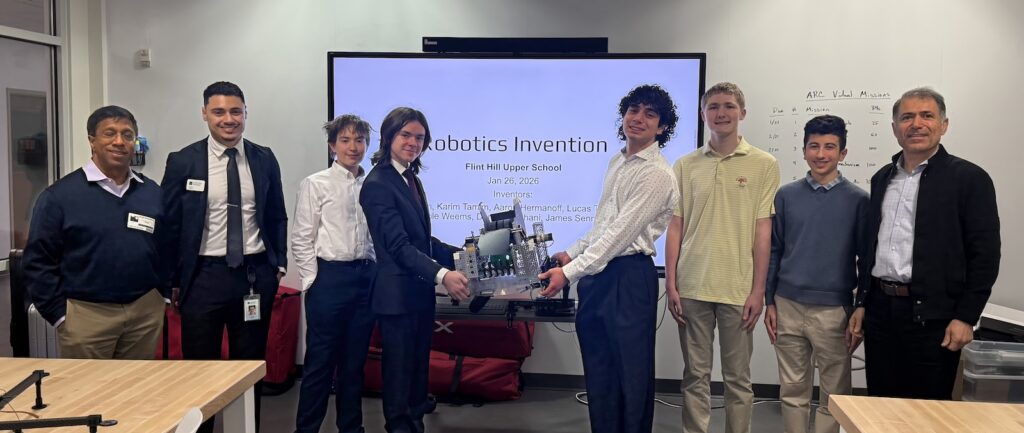
That’s why we’re proud to share that Ofinno Founder and CTO Dr. Esmael Dinan recently mentored a group of robotics students at Flint Hill School in Oakton, VA, through the process of developing and filing an official U.S. patent application.
On April 1, 2026, the team filed U.S. Patent Application No. 19/636,799, titled “Methods and Systems for Robot Coordination.” The application names student inventor Sina Dinan alongside co-inventors Aaron Hermanoff, Lucas Traczynski, Cole Weems, Darian Farahani, and James Sennott.
From Competition Problem to Patentable Solution
The project grew out of a real technical challenge the students encountered on the competition floor of the FIRST Tech Challenge (FTC), a robotics competition for students in grades 7–12. The team realized that when robots operate individually, it’s extremely difficult to maximize scoring efficiency on a shared ramp. They needed a system that would allow two robots to coordinate in real time — assigning roles, sharing data, and adapting strategy on the fly.
Over several months, Dr. Dinan joined the team during after-school hours to guide them through the full invention process: identifying the core technical problem, brainstorming and refining solutions, researching prior art, and documenting the system with the rigor and specificity required for a patent filing.
The result is a sophisticated coordination system that introduces a dynamic “Collaboration Mode” in which two robots communicate to assign complementary roles — a “Dynamic State” for collecting and positioning artifacts, and a “Throw State” for launching them into the goal. The system uses real-time performance data, including throwing accuracy, historical scoring rates, and ball transfer efficiency, to swap roles or fall back to an independent operating mode when collaboration isn’t yielding optimal results.
For the students, this experience went far beyond writing code for a competition. They learned what it takes to move from a technical idea to a formal intellectual property filing — a process that requires precision, discipline, and the ability to articulate exactly what makes an invention novel and useful. They navigated prior art searches, iterated across internal teams, and ultimately merged competing approaches into a unified solution strong enough to file.
These are the same skills that drive Ofinno’s work every day. Our integrated model — where researchers and patent attorneys collaborate from the earliest stages of an idea — exists because we believe the best patents come from deep technical understanding paired with rigorous IP discipline. Watching a group of high school students go through that same process, and seeing the quality of work they produced, was genuinely inspiring.
We congratulate Sina, Aaron, Lucas, Cole, Darian, James, and their teacher Karim Tamim on this remarkable achievement. The patent application is now with the United States Patent and Trademark Office and is expected to be published in the coming months.