


Key Takeaway
- The Joint Call for Proposals (CfP) on video compression beyond VVC is out. The Joint Video Experts Team (JVET) and its ITU-T and ISO/IEC parent bodies formally opened the competition for the next generation of video coding beyond Versatile Video Coding (VVC). Responses are evaluated in January 2027, and a first version of the new standard is targeted for October 2029.
- The Enhanced Compression Model (ECM) era closes at version 20. With the ECM-based exploration concluded, ECM 20.0 stands as the final feature release of the platform that accumulated close to 28% average luma bitrate savings over the VVC reference in random-access coding. Remaining work is maintenance only, and the accumulated tool knowledge now flows into CfP submissions.
- Gaussian splat coding (GSC) is preparing its own competition. The joint exploration sharpened the SEI-based carriage framework, agreed stricter evidence rules for inclusion, refreshed the common test conditions, and prepared a draft Call for Proposals for GSC together with a call for new test materials.
- Neural video coding keeps compounding. The Exploration Experiment on Neural-Network-based Video Coding (EE1) adopted dynamic-convolution in-loop filtering and motion-compensated deep reference frame generation, and conditionally adopted 8-bit quantized neural intra prediction, heading into version 18 of the NNVC software. A real-time end-to-end AI codec demonstration on consumer devices underlined how quickly this field is maturing.
- VSEI version 5 development formally begins. A first working draft of additional SEI messages for VSEI version 5 consolidates twelve messages and extensions, spanning content authenticity, display composition, film grain, and camera metadata.
Overview
The 43rd JVET meeting was hosted 7 – 15 July 2026 at ITU headquarters in Geneva, Switzerland, under ITU-T auspices, as a physical meeting with remote participation; sessions ran on every day of the window, the weekend included. The Joint Video Experts Team of ITU-T and ISO/IEC worked through more than 200 registered documents covering its full portfolio: maintenance of the AVC, HEVC, VVC, VSEI, and CICP (coding-independent code points) standards lines, the two running explorations on neural network-based coding and Gaussian splat coding, and, above all, the finalization of the Joint Call for Proposals.
The defining storyline of this cycle is a handover from exploration to competition. For the past several years, the Enhanced Compression Model has served as the evidence base that compression meaningfully beyond VVC is achievable; that phase is now closed, and the same ambition has been converted into an open competition: an issued Call for Proposals with anchors, test cases, and a timeline. In parallel, the exploration engine keeps running where the technology is younger: neural coding tools continued to be adopted into the NNVC test bed, and Gaussian splat coding matured its framework to the point of drafting a call of its own. High-level syntax was the single busiest track of the meeting, crowned by the start of VSEI version 5.
This readout covers, in order of consequence: the issued CfP and its road to January 2027; the ECM 20.0 wrap-up and what replaces it; Gaussian splat coding; the EE1 neural-coding cycle; and the VSEI version 5 kickoff alongside the maintenance line.
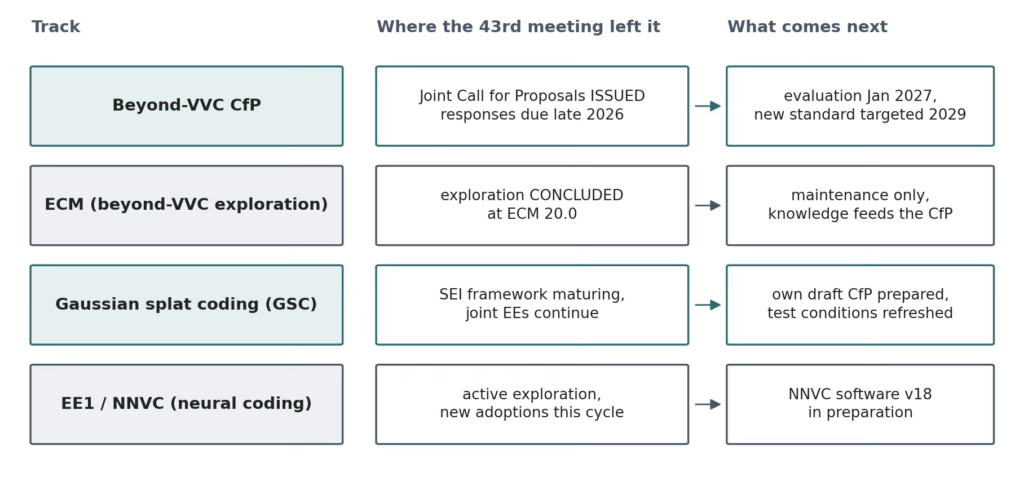
Figure 1. Four tracks defined the 43rd meeting cycle, each at a different point on the arc from exploration to standardization.
The Joint Call for Proposals: the Next Generation Formally Begins
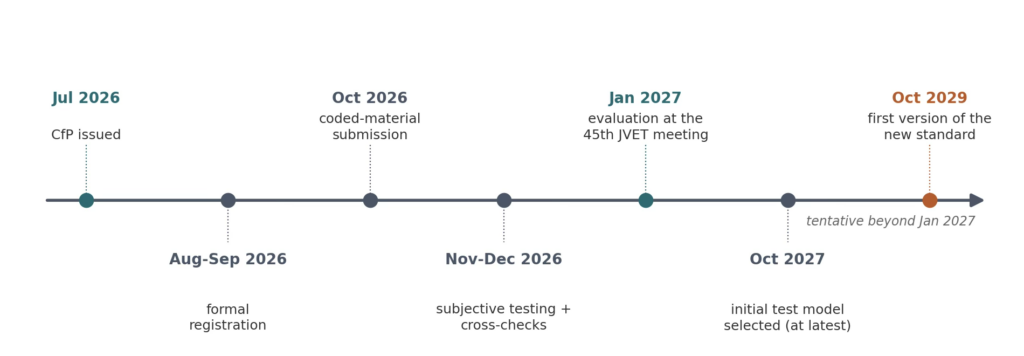
Every major video coding generation begins with a Call for Proposals, the formal invitation for organizations to submit candidate technology into a competitive, formally evaluated process. After a preparation arc that ran through a Call for Evidence and successive draft texts, the 43rd meeting completed that preparation: the Joint Call for Proposals on video compression with capability beyond VVC (JVET-AQ2021) was approved jointly with the parent bodies and issued on 17 July 2026. The Call targets technology that substantially exceeds VVC in compression capability and implementability, across a deliberately broad range of content and applications.
What the Call Asks For
Four test cases are defined: one for improved compression at large, and three for improved compression under runtime-constrained encoding, with encoder run-time targets of approximately 5x, 1x, and 0.2x of the VVC reference encoder (VTM). The structure is a statement of intent: the next standard is being scoped not only for maximum compression but explicitly for practical encoder economics from day one.
The content categories span standard dynamic range (SDR) streaming at UHD/4K and HD resolutions, low-delay conversational HD, high dynamic range (HDR) streaming with both the PQ and HLG transfer functions, low-delay gaming, and user-generated content (UGC), much of it in vertical format. Formal subjective testing will be conducted at four rate points per sequence, with objective metrics evaluated across wider rate ranges. A companion template for proposal description documents (JVET-AQ2022) standardizes how proponents must document their decoder and encoder algorithms and report complexity, and is planned to be finalized at the 44th meeting. Looking past the evaluation, the group also leaned toward moving PSNR reporting from picture-averaged to sequence-level calculation for the coming development phase, with details under study.
The Road to January 2027
The execution schedule is tight. Formal registration opens 1 August 2026 and closes 1 September 2026. Coded submission packages are due 26 October 2026, after which formal subjective assessment runs from early November to late December 2026, in parallel with mandatory cross-checking among proponents. Proposal description documents are due 6 January 2027, and the responses will be evaluated at the 45th JVET meeting, 13 – 22 January 2027 in Brisbane, AU. The anticipated timeline beyond that point is tentative but concrete: an initial test model selection process begins immediately after evaluation and is to be completed by October 2027 at the latest, with the first version of the new standard targeted for completion in October 2029.
ECM 20.0 Closes the Exploration Chapter
For the past several years, the Enhanced Compression Model (ECM) has been the vehicle in which JVET accumulated non-neural coding-tool advances beyond VVC, cycle after cycle. That effort has now concluded. The exploration experiment behind it was finalized at the 42nd meeting, and its last adoptions were integrated into ECM 20.0, released on 23 June 2026. The algorithm description of ECM 20 (JVET-AP2025) stands as the closing record of the platform; no further feature releases are planned.
The Benchmark It Leaves Behind
The cumulative result defines the benchmark the CfP must now beat: ECM 20.0 delivers close to 28% average luma bitrate reduction over the VTM reference in random-access coding of natural content, and around 43% on screen content. Going forward, the software is in maintenance-only mode under the ad hoc group (AHG) on enhanced compression, and the meeting recorded that the ECM test-conditions document is not planned for further updates and is not intended as a basis for future standards development. In a telling structural move, the AHG slot formerly dedicated to ECM software development was re-chartered to catalog and surface JVET’s non-reference software assets.
A Clean-Slate Handover
A complementary handover also took shape on the software side: a “clean slate” codebase contributed by Ericsson, Fraunhofer HHI, and Nokia (JVET-AQ0194) was adopted into the enhanced-compression repository. It offers a readable, well-optimized base derived from VTM without the ECM tool stack, intended as neutral ground for encoder-side experimentation as the community’s attention pivots to the CfP.
Gaussian Splat Coding Builds toward Its Own Call
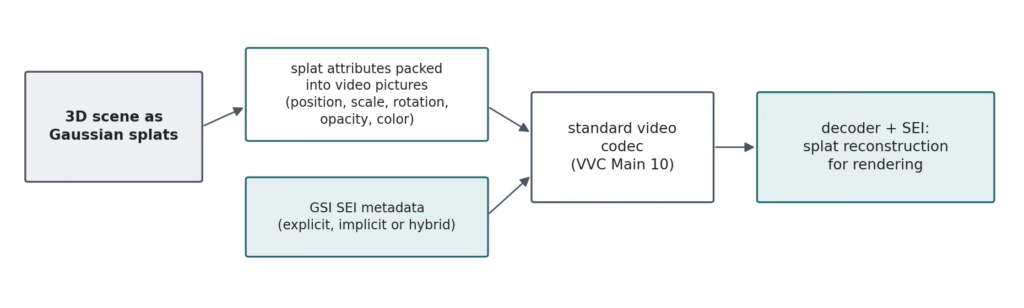
Gaussian splat coding represents 3D scenes as collections of Gaussian primitives whose position, scale, orientation, opacity, and color parameters can be packed into ordinary video pictures and carried through existing video codecs. A Supplemental Enhancement Information (SEI) message, the Gaussian splatting information (GSI) message, tells the decoder how to reconstruct the splats for rendering. The activity is run jointly by JVET, the MPEG video and 3D graphics working groups, and ITU-T VCEG, and flows through nine joint exploration experiments, of which the two SEI-related ones (JEE 6.7 and JEE 6.9) run through the JVET SEI track. With about fifty contributions in this space, it was among the most active areas of the meeting.
The Specification Consolidates
This cycle brought a broad consolidation of the specification itself. The GSI design was refined through syntax and semantics contributions from across the industry, and the technologies-under-consideration document now hosts three complementary flavors of the design: an explicit representation, an implicit representation built on neural feature planes with triplane video, and a hybrid of the two, with agreed clean-ups landing on the implicit variant. The framework also took clear steps toward deployment-grade engineering: the splat reconstruction pipeline moved to integer operation in the software, integer representation of quantization and transform parameters was agreed into the next document round, and spatial random access was implemented and cross-checked.
Tightening for Competition
At the program level, the joint activity tightened its process and set course for competition. Formal evidence rules were agreed for including proposals in the exploration or the specification pipeline, requiring complete text, software, results under common test conditions, and independent cross-checks. Refreshed common test conditions for Gaussian splat coding were issued (JVET-AQ2028), and the joint activity prepared a draft Call for Proposals for GSC along with a call for new test materials, the clearest signal yet that this track is heading toward a competitive phase of its own.
EE1: Neural Coding Tools Advance toward NNVC 18
What Was Adopted
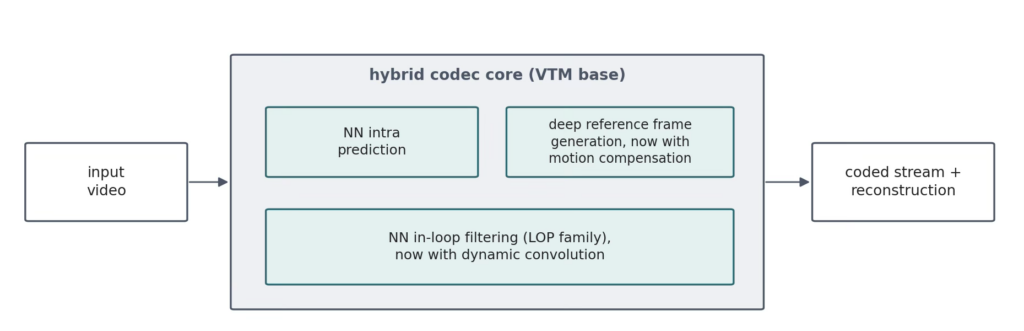
The Exploration Experiment on Neural-Network-based Video Coding (EE1) remains JVET’s vehicle for maturing neural tools inside a standard hybrid codec, hosted in the Neural-Network-based Video Coding (NNVC) test bed. Three tool families moved this cycle. Dynamic convolution was adopted into the low-operating-point in-loop filtering (LOP) family as its next generation (JVET-AQ0071), improving compression at unchanged per-pixel arithmetic complexity, at the cost of a larger parameter count. Deep reference frame generation for inter prediction was upgraded across all model sizes with motion-compensated inputs (JVET-AQ0050), and a very small variant joined the default configuration. For neural intra prediction, an 8-bit weight-quantization scheme was conditionally adopted (JVET-AQ0182), trimming model memory by more than 40% with negligible coding loss, pending final software confirmation.
Software: Faster and Closer to Real Time
The software story is equally telling. The group’s neural inference library gained a GPU back end that produces bit-exact results relative to the CPU path, translating into multi-fold decoder speedups on the neural anchor. The updated algorithms description and software reference were issued as version 16 and version 18 respectively (JVET-AQ2019), with the NNVC 18.0 codebase planned for the end of July 2026. Adding color to the trajectory, an informative demonstration of a real-time end-to-end AI video codec running on a consumer laptop and phone (JVET-AQ0173) showed Full-HD playback on built-in neural accelerators, a marker of how fast neural video coding is approaching practical deployment.
VSEI Version 5 and the Maintenance Line
High-level syntax was the largest single track of the meeting, and it produced a milestone: development of version 5 of the Versatile SEI messages standard (VSEI) began with a first working draft of additional SEI messages (JVET-AQ2006). Twelve messages and extensions graduated from the technologies-under-consideration pipeline, including new messages and extensions covering digitally signed content (content authenticity), film grain region characteristics, localization and mapping, lens optical correction, display overlays and display rectangles, comment-overlay (danmu) information, and encoder optimization information. The technologies-under-consideration pipeline rolled to version 13 (JVET-AQ2032) under stricter inclusion criteria.
The maintenance line advanced in step. The draft of additional HEVC profiles, adding multiview 4:4:4 10-bit and 12-bit profiles, moved toward an ISO/IEC amendment ballot, with the corresponding multiview conformance-testing draft progressing alongside it. The second edition of the technical report on film grain synthesis technology advanced to ballot as a committee draft, and errata were consolidated across VVC, VSEI, HEVC, AVC, and the video code-point standard.
What’s Next
The 44th JVET meeting runs 17 – 23 October 2026 in Hangzhou, CN, with a document deadline of 9 October 2026. From January 2027 onward, meeting slots stretch to 10 – 11 days in anticipation of the development phase of the next-generation standard. The threads to watch:
- CfP execution. Registration runs 1 August to 1 September 2026; coded submission packages are due 26 October 2026; subjective testing proceeds through late 2026; responses are evaluated at the 45th JVET meeting in Brisbane, AU, 13 – 22 January 2027.
- Next-generation development. Initial test model selection begins after the January 2027 evaluation and completes by October 2027 at the latest, with the first version of the new standard tentatively targeted for October 2029.
- Gaussian splat coding. The next joint-exploration round runs under the refreshed common test conditions and the new evidence rules, while the draft GSC Call for Proposals matures toward issuance.
- EE1 and VSEI. NNVC 18.0 software lands at the end of July 2026 with the newly adopted tools; the VSEI version 5 draft advances toward the October meeting.
About this readout. This document was prepared from publicly available JVET documents, including the daily meeting notes for the 43rd JVET meeting. For the most up-to-date status, refer to the official JVET output documents at https://jvet-experts.org.