


Key Takeaways
JVET locks in its Final Draft Joint Call for Proposals (CfP) on next-generation video coding. The 42nd JVET meeting closed at 17:14 CEST on 1 May 2026 with the Final Draft CfP, JVET-AP2026, approved. Test conditions are frozen. Submissions for the next major video coding standard will be received against this fixed test set. Finalization of the public CfP is targeted for mid-2026.
Ofinno’s quantization research validated by seven independent industry cross-checks. Ofinno contributed an Enhanced Compression beyond VVC capability (EE2) study on a QP-adaptive dead-zone in quantization, with cross-checks from WILUS, OPPO, Alibaba, Dolby, Google, vivo, and Qualcomm — a notable breadth of validation across leading industry participants. The 42nd JVET meeting was also the cycle in which the EE2 framework wrap-up came into view, with two tool refinements integrated into the final Enhanced Compression Model (ECM 20.0) release.
Gaussian Splat coding consolidates into a structured two-track exploration program. The Joint Ad-Hoc Group on Gaussian Splat Coding (spanning JVET / WG 5, MPEG WG 4, and MPEG WG 7), which has been in operation across recent meeting cycles, closed the 42nd JVET meeting having chartered two formal Joint Exploration Experiments — JEE 6.7 (video-based coding for the Lightweight scenario) and JEE 6.9 (encapsulation / high-level syntax). Common test conditions for GS coding were issued as JVET-AP2028. Fourteen SEI message contributions on Gaussian splatting were also processed during the meeting, with the majority slated for the Technologies under Consideration (TuC) document.
Exploration Experiment on Neural-Network-based Video Coding (EE1) advances neural video coding with a new adoption and continues as the only formal video-coding EE for the next cycle. RDO-based multi-layer frame-level switching for the end-to-end AI intra interface was adopted into the Neural-Network-based Video Coding (NNVC) software. SADL improvements and an alternative memory-allocation method were also adopted as software changes. With EE2 discontinued from the next cycle, EE1 is the sole formal Exploration Experiment on video coding aspects entering the next cycle.
Overview
The 42nd JVET meeting (24 April – 1 May 2026, Santa Eulària, ES) marks a turning point in the video coding standardization roadmap. The current generation work — Versatile Video Coding (VVC), Versatile SEI (VSEI), and the Enhanced Compression Model (ECM) test bed — has matured into a maintenance-and-finalization phase. The Final Draft Joint Call for Proposals on video compression with capability beyond VVC, JVET-AP2026, was approved at meeting close on 1 May. It will frame the technology submissions that ultimately drive the next major standard.
Within that broader Call-for-Proposals frame, Ofinno contributed a study on adaptive quantization to the Exploration Experiment on Enhanced Compression beyond VVC capability (EE2). The study received seven independent cross-checks from leading industry participants. The 42nd JVET meeting was also the cycle in which EE2’s framework wrap-up was confirmed: two industry tool refinements were adopted for ECM 20.0, which will be the final ECM release before the EE2 framework is discontinued.
Two further threads broadened the scope of JVET activity. Gaussian Splat coding, previously a niche topic in volumetric and immersive video, consolidated during the cycle from informal coordination into a structured two-track Joint Exploration Experiment program. And the Exploration Experiment on Neural-Network-based Video Coding (EE1) continued to deliver tooling improvements at a steady pace, with its first end-to-end AI intra-frame interface mechanism formally adopted into the Neural-Network-based Video Coding (NNVC) reference software. EE1 will be the only formal Exploration Experiment on video coding aspects entering the next cycle.
This readout covers, in order of cycle priority, the Final Draft CfP and what its freeze means for the next round of submissions; Ofinno’s contribution to the EE2 cycle and the broader EE2 framework wrap-up; the existing Joint Ad-Hoc Group on Gaussian Splat Coding, the two newly chartered Joint Exploration Experiments, and the JVET-side contributions that fed into them; and the state of EE1 as it advances multiple neural tools.
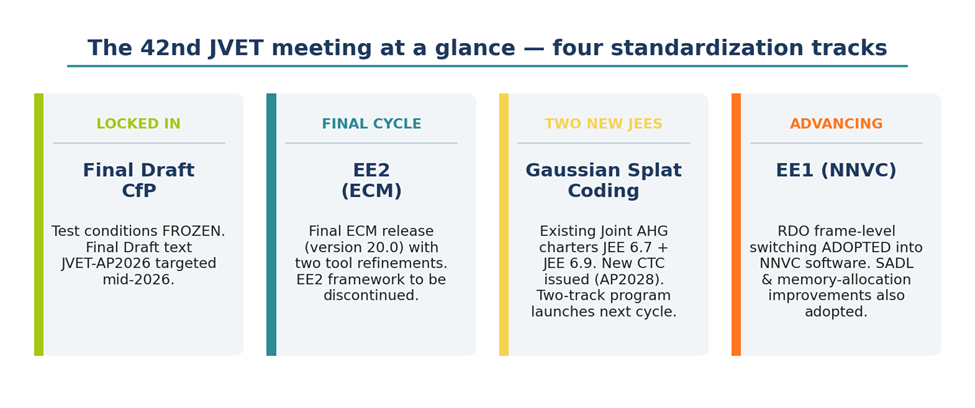
Figure 1: Four parallel standardization tracks defined the meeting cycle, each at a different stage of maturity. The order reflects the priority placed on each track during the meeting.
Final Draft CfP: Locking In Test Conditions for the Next Generation
Every major video coding standard begins with a Call for Proposals — a formal invitation to industry participants to submit candidate technology that will be evaluated against a fixed test set under consistent conditions. The 42nd JVET meeting concentrated on producing the Final Draft text, JVET-AP2026, and on freezing the test conditions that will govern the formal submissions. The CfP was the meeting’s primary output and the principal focus across multiple plenary and main-track sessions.
What Was Locked In
The CfP working draft entered the meeting as JVET-AP0047, the in-meeting working version edited from the previous Final Draft input (JVET-AO2026). Across multiple plenary and main-track sessions, the working draft progressed from version 3 to version 6 as decisions on rate points, sequences, and reporting requirements were integrated.
Ad-Hoc Group 17 (AHG17), the body charged with preparing the CfP, came into the meeting having held three online ad-hoc calls (3 February, 10 March, and 26 March 2026) and a hybrid interim meeting in Aachen, DE, on 25–27 February 2026. Fourteen contributions were submitted to AHG17 at the 42nd JVET meeting, split between four addressing the proposed CfP text and ten focused on test sequences, rate points, and configuration choices.
Among the agreed CfP-text changes, JVET-AP0202 was adopted in full: the CfP will now require per-frame PSNR reporting in addition to the per-frame bit-count reporting already specified, allowing alternative combined YUV metrics to be computed post-hoc and consistently across submissions. Reported precision stays at the precision delivered by HDRTools by default. JVET-AP0042 editorial proposals were partially incorporated into the AP0047 working draft.en direction.
Sequence and Rate Point Decisions
Two rounds of expert viewing fed the test-set decisions. A dry-run held during the Aachen interim was followed by a second dry-run conducted onsite in Santa Eulària, with first results presented on 26 April. A side-activity team analyzed the viewing results on 28 April and reported back the same afternoon. The panel observed that experts at the Santa Eulària viewing assessed quality more critically than at the Aachen interim, leading to a series of refined rate-point recommendations.
On sequence selection, the meeting agreed to test the candidate set consolidated in JVET-AP0279 with rate points 1 through 4, plus a second variant of rate point 4 for the Fashion Lady sequence. In the Surveillance / Restricted-Hue (SRH) category, Driving POV is replaced by a new Traveller Swim sequence proposed by Xiaomi (JVET-AP0280). One Wukong sequence and one Carla driving-simulator sequence (Huawei, JVET-AP0044) join as additional gaming candidates. A separate set of HDR/UHD gaming sequences proposed by Fraunhofer HHI and Huawei (JVET-AP0050) and the BBC’s Liverpool sequences (JVET-AP0064) will be included in viewing but not promoted as new CfP candidates in this cycle.
Modified rate-point ranges were agreed across the consolidated test set. The side-activity report was presented in plenary without objections, signaling broad consensus that the test set is ready to support submissions.
What’s Next on the CfP Timeline
With test conditions effectively frozen and the working draft consolidating across versions, the principal focus for the next standardization cycle shifts from drafting the CfP to preparing technology responses. The Final Draft text JVET-AP2026 is targeted for finalization in mid-2026, and the joint cross-WG meeting between MPEG WG 2 (Requirements), JVET (WG 5), MPEG AG 5 (Visual Quality Assessment), and ITU-T VCEG on 29 April was dedicated to next-generation requirements and the CfP presentation, broadening the conversation beyond the JVET community.
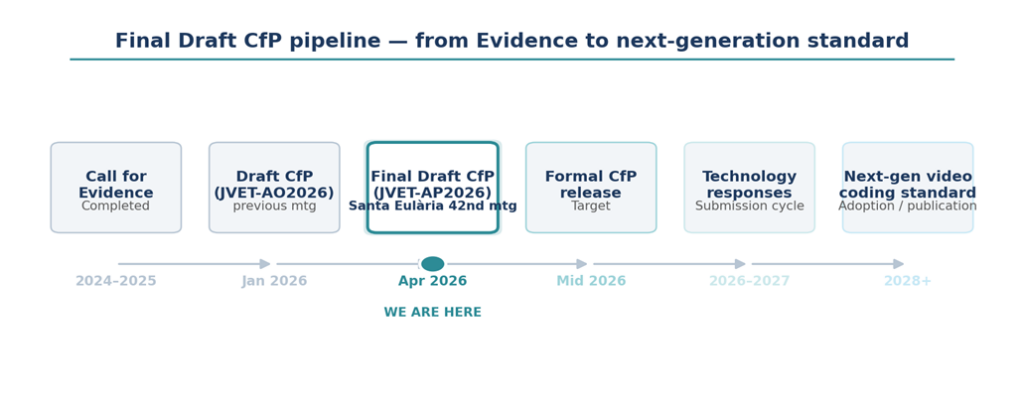
Figure 2. The CfP pipeline progressed through a Call for Evidence and a first Draft CfP at the previous meeting; the 42nd JVET meeting froze the test conditions in the Final Draft, with formal release targeted mid-2026.
Ofinno’s Adaptive Quantization Study and the EE2 Wrap-Up
The Exploration Experiment on Enhanced Compression beyond VVC capability (EE2) has driven traditional, non-neural coding-tool research at JVET for several cycles, feeding tools into the Enhanced Compression Model (ECM) reference software. The 42nd JVET meeting was the cycle in which Ofinno contributed an adaptive-quantization study into EE2 and in which the EE2 framework itself entered its planned final stage.
Ofinno’s Contribution: A QP-Adaptive Dead-Zone in Quantization
Ofinno contributed JVET-AP0059 to the EE2 cycle: an investigation into a QP-adaptive dead-zone in quantization. The proposal introduces a quantization offset of the form ρ = a · QP + b, where the linear coefficients differ by slice and channel type and are signaled as SPS-level syntax elements with optional slice-level updates. The technique extends the existing Quantization Constant Stretching (QCS) inverse-quantization offset mechanism in the ECM with a reconstruction-side adjustment and a corresponding encoder-side offset that align the encoder and decoder around the new dead-zone shape.
The study spanned multiple sub-tests, exercising the offset on the encoder side, the inverse-quantization side, and both, under both common test conditions and a configuration using rate-distortion optimized quantization across all residual coding.
Industry Validation: Seven Independent Cross-Checks
The contribution received seven independent cross-check reports during the meeting cycle, from WILUS, OPPO, Alibaba, Dolby, Google, vivo, and Qualcomm — a notable breadth of validation across leading industry participants. Such depth of cross-checking is uncommon for a single proposal and reflects industry interest in the QP-adaptive dead-zone direction.
The technical study direction is being carried forward into the next exploration cycle as four sub-tests, with Ofinno acting as the tester. The set retains coverage of the dead-zone mechanism under both Dependent-Quantizer and RDOQ regimes, including in non-CTC configurations where prior results suggested that explicit signaling of the inverse-quantization offset becomes more impactful.
EE2 Framework Wrap-Up: Two Tool Refinements for ECM 20.0
Within the broader EE2 framework, two tool refinements were adopted into ECM 20.0 at the 42nd JVET meeting:
- JVET-AP0086 Test 2.1a: a modified Geometric Partitioning Mode (GPM) that incorporates a refined offset direction derivation, improving partition-mode flexibility for inter-prediction blocks.
- JVET-AP0168 Test 1.3: refined clipping operations in the Cross-Component Convolutional Model (CCCM) modes, with adjustments to the clipping range to match the dynamic range of intermediate values.
ECM 20.0 is planned for release on 22 May 2026 with these adoptions integrated. The closing plenary on 1 May confirmed that EE2 is discontinued from the next cycle and that ECM development is unlikely to be further continued after the 20.0 release. Tool-level investigation in the traditional (non-neural) coding domain will increasingly migrate toward the CfP response track and to the broader research community, while neural-tool work continues in EE1.
Gaussian Splat Coding: Two New Joint Exploration Experiments Chartered
Gaussian Splat coding (GSC) represents 3D scenes as collections of anisotropic Gaussians whose positions, scales, orientations, and color information can be rendered to produce novel views. The technology has matured rapidly over the last two years to become a leading representation for volumetric and immersive video applications. At the 42nd JVET meeting, the existing Joint Ad-Hoc Group coordinating GSC work advanced its program from informal exploration into a structured two-track Joint Exploration Experiment setup.
The Joint Ad-Hoc Group Charters Two New Joint Exploration Experiments
The Joint Ad-Hoc Group on Gaussian Splat Coding operates jointly between JVET / WG 5, MPEG WG 4 (Video), and MPEG WG 7 (3D Graphics) and has been active across recent meeting cycles. Hosting WG rotates per cycle: WG 7 hosted the activity at the 42nd JVET meeting, with WG 4 taking over at the next meeting. The 1 May closing plenary confirmed two newly chartered Joint Exploration Experiments — JEE 6.7 (video-based coding for the Lightweight scenario) and JEE 6.9 (encapsulation / high-level syntax for Gaussian splats) — replacing the earlier single-track exploration setup that the Joint AHG had been coordinating to date.
The intensity of cross-WG sessions during the meeting week underscores the seriousness with which the activity is being pursued. The Joint AHG met for an extended 26 April session from 09:00 to 13:30, with no parallel JVET sessions scheduled. Joint sessions with WG 4, WG 7, and ITU-T VCEG followed each afternoon Monday through Wednesday from 16:00 to 18:00, with a final consolidation session on 30 April from 08:30 to 10:30 dedicated to defining common test conditions, anchors, and joint exploration experiment descriptions. The JEE 6.9 description was formally presented in the 1 May plenary.
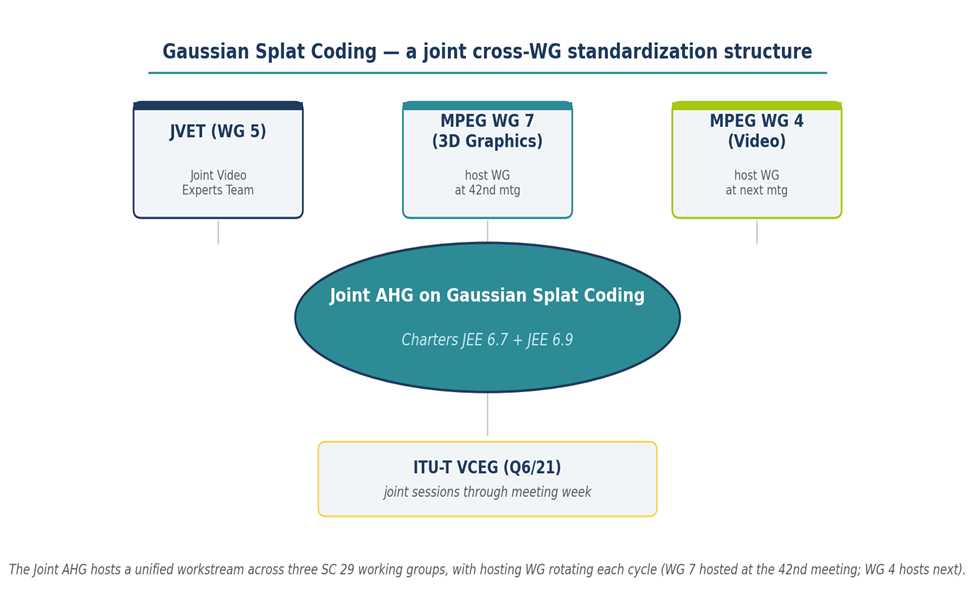
Figure 3. Three SC 29 working groups and ITU-T VCEG converge on the Joint AHG and JEE 6.9, with hosting WG rotating each cycle.
The Path to Common Test Conditions
The Joint AHG’s mandate covers the full breadth of GS standardization preparation — use cases and requirements, data sets, common test conditions, anchors, software tools, encapsulation and high-level syntax, subjective evaluation, and cross-WG coordination — with a dedicated workstream on the Lightweight GS scenario running in parallel with the broader program. Common test conditions for Gaussian splat coding were issued from the 42nd meeting as JVET-AP2028, and the JEE 6.7 / JEE 6.9 program provides the structured exploration vehicle going into the next cycle.
EE1 (Neural-Network-Based Video Coding): Tools Advance Toward NNVC 16
The Exploration Experiment on Neural-Network-based Video Coding (EE1) continues to be the most active vehicle for integrating neural tools into JVET’s reference software, NNVC. EE1 is structured around five tracks: low-operating-point in-loop filtering (LOP), variable-LOP in-loop filtering (VLOP), neural inter-prediction reference frame generation (NN-Inter), end-to-end AI codec frameworks for externally coded pictures, and operational bit-exact reproducibility. Twenty-four neural-network-related contributions were submitted to the 42nd JVET meeting.
What Was Adopted
The most significant EE1 outcome at the 42nd JVET meeting is the adoption of an RDO-based multi-layer frame-level switching mechanism for the end-to-end AI intra-frame interface, drawn from JVET-AP0080 and JVET-AP0183. The mechanism enables the encoder to select between conventional intra coding and an end-to-end learned intra codec on a per-frame basis using rate-distortion optimization. The framework was tested with both DCVC-RT and NLIC E2E AI image codecs as the learned-intra component, and frame-level switching consistently improved compression while reducing decoding runtime relative to fixed-mode operation.
Single-layer end-to-end AI intra approaches were investigated alongside the multi-layer framework but did not show comparable benefit at this stage. The meeting recorded that further investigation in the next exploration cycle appears necessary on identifying the potential benefits of the single-layer approach. Two software-level adoptions also entered the NNVC code base at the meeting: SADL operator improvements (drawn from JVET-AP0053) and an alternative memory-allocation method (JVET-AP0211) selectable at user choice.
Software Status
NNVC version 16.0 software was approved and is the current reference vehicle for neural-tool experimentation. Algorithm description and software documentation are being progressed in JVET-AP2019 (Description of algorithms version 14 and software version 16). Anchor performance against VTM, organized by AHG14, is published in the JVET software repository.
What’s Next
The next major milestone is the 43rd JVET meeting, planned for 7–15 July 2026 in Geneva, Switzerland, under ITU-T SG 21 auspices. The agreed document deadline for the next meeting is 30 June 2026. The intervening period will see continued AHG telco activity and AHG-level interim work on the topics outlined below.
- Final Draft CfP. The Final Draft text JVET-AP2026 was approved at meeting close and will be finalized in mid-2026 ahead of the formal Call distribution to potential proposal contributors. VTM 24.0 is the reference software for CfP submissions.
- Ofinno’s research direction and EE2 wrap-up. Ofinno’s QP-adaptive dead-zone quantization study will be repositioned for continued investigation. Within the EE2 framework wrap-up, ECM 20.0 is planned for release on 22 May 2026 with the two tool refinements taken at the meeting, after which the EE2 framework is discontinued and traditional-tool research migrates toward the CfP response track.
- Gaussian Splat Coding. The two-track Joint Exploration Experiment program (JEE 6.7 and JEE 6.9) starts the next cycle. The Joint AHG continues with WG 4 hosting at the next meeting. Common test conditions are issued as JVET-AP2028, and the broader cross-WG collaboration on GS encapsulation and conformance dimensions will continue.
- EE1 (NNVC). NNVC 17.0 is planned for release on 29 May 2026. The multi-layer end-to-end AI intra interface will be exercised with the newly adopted RDO frame-level switching; further study of single-layer end-to-end AI intra approaches and of bit-exact-friendly neural inference will continue. With EE2 discontinued, EE1 is now the only formal video-coding Exploration Experiment going into the next cycle.
About this readout. This document was prepared from publicly available JVET documents, including the daily meeting notes for the 42nd JVET meeting. For the most up-to-date status, refer to the official JVET output documents at https://jvet-experts.org.