


Key Takeaways
- RAN Working Group 1 converges on the bandwidth for the 6G synchronization signal: the group is set to design the 6G synchronization signal block (SSB), the periodic beacon, transmitted by the network, which a device searches for to find and lock onto a cell, assuming a bandwidth larger than 3 MHz, handling smaller 3 MHz spectrum allocations by adjusting that wider design. The alternative approach of a bandwidth target of less than 3 MHz, which some companies preferred, would enable the SSB to fit the smallest spectrum allocation a 6G network might use but would have come at the cost of decreased performance for the far more common wider bandwidth allocations. Because every connection begins with finding the SSB, the outcome shapes how fast and reliably 6G devices complete initial cell search.
- RAN Working Group 2 opens the central Layer 2 architecture question for 6G: the group will study two competing designs for the protocols that carry user data, keeping the 5G split between the Packet Data Convergence Protocol (PDCP) and Radio Link Control (RLC) layers or merging them. The pivotal question is whether the layers can share a single sequence number, the counter a receiver uses to reorder packets, among other functions. A single number could trim up to roughly 2 bytes of per-packet header overhead and simplify processing, and the group wants one common protocol stack across all deployments so the design does not create market fragmentation.
- SA Working Group 2 provisionally agrees to high-level principles for a modular 6G control plane: building on proposals first tabled in February, the group provisionally agreed, as a working baseline, on the principle of separating the function that routes control-plane messages from the one that manages access and mobility, placing routing in its own dedicated network function. This is an agreement on high-level principles rather than a decision to adopt the solution; whether it is introduced into the 6G system will be settled later, at the 6G study conclusion stage. The proposed direction targets a 5G constraint in which this signaling is concentrated in a single function, the Access and Mobility Management Function (AMF), and it advanced alongside work to embed artificial intelligence in the 6G core and a new study to modernize the IP Multimedia Subsystem (IMS), the framework behind voice, video, and messaging, for 6G.
Overview
3GPP’s RAN Working Group 1 (RAN1), RAN Working Group 2 (RAN2), and SA Working Group 2 (SA2) met and convened together in Dalian, China, from May 18 to 22, 2026.
These were Release 20 meetings, covering the Study on 6G Radio and its system-architecture counterpart. The RAN plenary’s guiding principle for 6G, a call for “lean and streamlined” standards that avoid the sprawl of options and configurations that accumulated in 5G, again framed the week.
If the February meetings marked the shift from cataloging 5G’s limitations to proposing 6G solutions, the May meetings were about converting those proposals into agreed baselines. The same pattern recurred in all groups: a baseline architecture, a baseline procedure, or a baseline set of assumptions was fixed as the common starting point, with the harder detailed-design choices deliberately left open for study. Two threads ran through the entire week: the steady weaving of artificial intelligence and machine learning into every layer, from the air interface to the core, and an unusually heavy volume of cross-working-group coordination, as a decision in one group increasingly hinged on dependencies or inputs from another.
This readout follows one headline development from each group: the synchronization-signal decision in RAN1, the Layer 2 user-plane architecture in RAN2, and the modular control-plane principles in SA2.
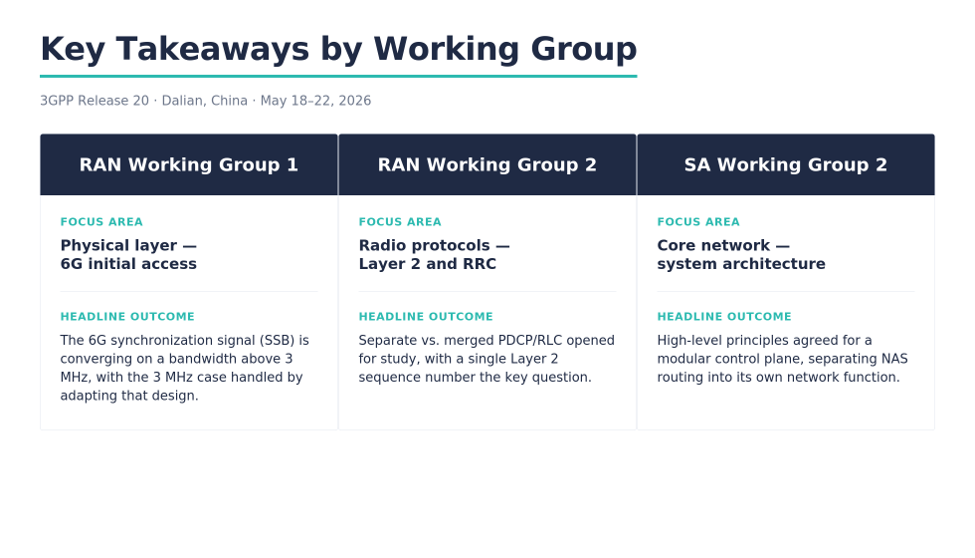
Figure 1: Key Takeaways by Working Group, showing the meeting, focus area, and headline outcome for each group covered (Dalian, China; May 18–22, 2026).
RAN Working Group 1: Setting the Foundation for 6G Initial Access
RAN Working Group 1 owns the physical layer, the lowest level of the radio system, where data is turned into the actual signals that travel over the air. Its decisions cover waveforms, channel coding, the reference signals a device measures, and the precise structure of what gets transmitted. At the Dalian meeting, with a RAN plenary checkpoint on the 6G study approaching, much of the group’s attention fell on one of the most basic building blocks of any cellular system: the signal a device uses to find the network in the first place.
When a phone powers on or moves into a new area, it cannot do anything until it locates a cell, which it does by scanning for a periodic beacon called the synchronization signal block (SSB), carrying the timing and identity information a device needs to lock onto a base station. The bandwidth of that signal turns out to be a consequential design choice. A narrower SSB can fit inside a smaller slice of spectrum, which matters for operators deploying 6G in constrained bands, but it limits how much information the signal can convey and how quickly and robustly a device can detect it. For several meetings, companies had been split: some argued for a target of at most 3 MHz so the SSB could fit inside the minimum 3 MHz spectrum allocation (with 15 kHz subcarrier spacing) a 6G network might be deployed with, while others wanted more room. At Dalian the balance came down clearly on the side of the larger design, defining the SSB assuming a bandwidth larger than 3 MHz and accommodating the 3 MHz case by adapting that wider design (e.g., puncturing).
That direction is foundational because it constrains everything built on top of it. The 6GR SSB itself was defined at the prior meetings as comprising primary and secondary synchronization signals together with a physical broadcast channel, the 6G counterpart to the structure 5G uses. With the SSB bandwidth decision made, the group turned to the detailed structure, agreeing that companies will report their proposed SSB structures and their assumptions on how a device combines repeated transmissions to improve detection. The work continues directly from the initial-access focus of the April meeting: in effect, the group is designing the first few milliseconds of a 6G connection, where the synchronization signal lives. As part of the SSB structure discussion, extending the SSB’s periodicity to let the network sleep longer and save energy, and repeating the SSB in time to help coverage-limited devices, remained active and recurring topics.
Another major thread concerned how a 6G device reports what it observes on the air. Channel state information (CSI) is the feedback describing current radio conditions that the network relies on to aim and shape its transmissions. As 6G scales up to larger antenna arrays, wider bandwidths, and more dynamic deployments, the conventional way of gathering this feedback threatens to become costly in overhead, latency, and device complexity, so the group is to study mechanisms for DL/UL CSI acquisition and to consider evaluation assumptions, both non-AI-based and AI-based, that obtain useful channel information more efficiently. Especially on DL CSI acquisition in this meeting, the evaluation assumption for AI-based Joint Source Channel coding and Modulation (JSCM), was discussed among companies with higher priority to verify the performance benefits and its feasibility of the methods. Also, related work on beam management, which covers how a device and network discover, refine, predict, and report the spatial domain beams 6G will rely on, advanced in parallel, with beam prediction and adaptive reporting emerging as promising directions, alongside continued study of a UE-initiated beam reporting and assistant information for the beam management.
RAN Working Group 2: The Layer 2 Architecture That Carries 6G Traffic
If RAN1 designs the physical layer signals, RAN2 designs the protocol layers that sit just above them. It owns the radio protocols, including the Layer 2 procedures that package data into packets, retransmit what gets lost, and prioritize traffic, together with Radio Resource Control (RRC), the protocol a base station uses to configure a device, page it, and manage its RRC connection state. The Dalian meeting produced agreements across a wide front, but the most consequential concerned the architecture of the protocol stack that carries user data.
In today’s networks, two Layer 2 sublayers handle that data in sequence. The Packet Data Convergence Protocol (PDCP) performs security, in-order delivery, header compression, and duplicate detection; the Radio Link Control (RLC) layer performs segmentation and reassembly (breaking packets into transmittable pieces and putting them back together) along with its own retransmissions. In 5G the two are separate, each keeping its own sequence number, the counter that lets a receiver put packets back in order, and each adding its own header. For 6G, RAN2 agreed to study both keeping this split and merging the two layers into one. The pivotal question running through the discussion is whether a single sequence number can serve the design, with merged or even separate protocol layers rather than two. A single number could shave up to roughly 2 bytes from the combined Layer 2 header and simplify processing, but it complicates segmentation, which the group left open, with one option being to push it down into the Medium Access Control (MAC) layer at the cost of added complexity there. Underpinning the effort is a clear goal: one common protocol stack across every supported scenario, so that an operator’s choice of deployment does not fork the design.
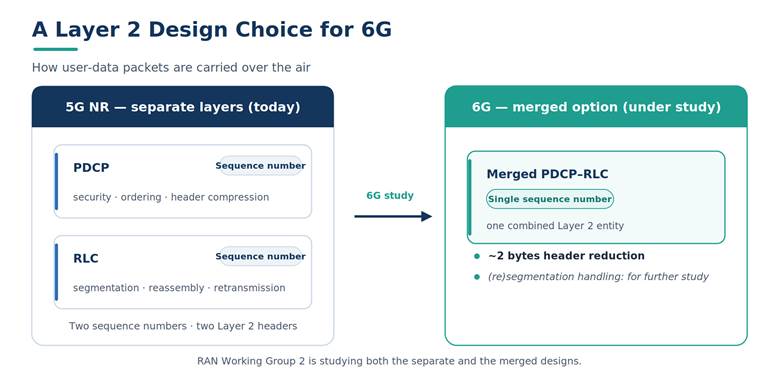
Figure 2: The 5G separate-layer baseline (left) and the merged, single-sequence-number option under study for 6G (right). RAN Working Group 2 agreed to study both separate and merged designs.
The group also began reshaping two long-standing pain points. It agreed to capture as a 5G shortcoming that the PDCP reordering mechanism demands high receiver memory at peak downlink throughput, adds latency, and cannot adapt to quality of experience, and to study simpler reordering mechanisms in response. On header compression, it flagged that the 5G uplink data compression scheme is processing-intensive and does not work on encrypted traffic, setting up a comparison of alternatives for the next meeting.
Beyond the user plane, several decisions advanced the protocol design. After a long-running debate, RAN2 resolved how a device behaves when a reconfiguration fails: rather than let the device apply only part of a new configuration (an approach it considered and rejected), the group will study a simplified procedure that skips selected steps, such as cell search and security-key derivation, to cut the service interruption the 5G re-establishment procedure causes. It confirmed that both two-step and four-step random access, the handshake a device uses to initiate access into the network, will be supported, with their common parts unified where possible; set a paging baseline (how the network reaches an idle or inactive device) built on 5G and preserving at least 5G-level capacity; and took first steps toward a unified energy-saving framework, jointly studying how connected-mode discontinuous reception, which lets a device sleep between checks for data, would work alongside a downlink wake-up signal. Artificial intelligence surfaced here too, and revealingly. On the transfer of AI models over the network, the group agreed that the operator should be able to tell a model transfer is happening (so it can manage congestion and set priority) without any visibility into the model itself, balancing an operator-driven traffic-management concern against a widely shared vendor view that no special network-side control is required. RAN2 also settled a security question, agreeing to reuse 5G parameters as inputs to the authenticated-encryption algorithms expected in 6G while keeping the message-integrity field at a fixed length. The week’s cross-group dependencies were captured in four approved outgoing liaison statements: to SA Working Group 3 on the encryption algorithm for PDCP security (R2-2604401), to SA2 on the transfer of AI/ML models (R2-2604407), to RAN1 on the transmission-grant types (R2-2604399), and to RAN4 on reducing mobility interruption time (R2-2604406).
SA Working Group 2: The Modular Control Plane and a 6G-Era IMS
Where the RAN groups design the radio, SA Working Group 2 designs the core network, the functions behind the radio that register devices, set up their data sessions, authenticate them, and manage their movement across the network. Its Dalian meeting pushed the 6G system architecture from the proposal stage it reached in February to provisionally agreed high-level principles, a working baseline, not yet a decision to adopt any solution.
The Non-Access Stratum (NAS) is the control messaging exchanged directly between a device and the core network, distinct from the radio-level signaling handled by the RAN. In 5G, NAS handling is concentrated in a single core function, the Access and Mobility Management Function, a centralization that limits flexibility as networks scale and the range of services widens. At Dalian, SA2 provisionally agreed the high-level principles for a modular NAS architecture that separates the routing of control messages from mobility management, placing the routing function in its own dedicated network function rather than inside the access-and-mobility function. What was agreed is the set of high-level principles behind the proposed solution, fixed provisionally as a common baseline; this is not a commitment to adopt the solution itself, and whether it is ultimately introduced into the 6G system will be decided later, at the 6G study conclusion stage. Building on that groundwork, the group began designing solutions for paging and mobility in earnest, taking aim at a 5G inefficiency in which mobility management is duplicated across the radio (access stratum) and core (non-access stratum) levels, and exploring how a 6G core might handle paging and the buffering of waiting downlink data uniformly across a device’s idle and inactive states. Beneath these threads sits a foundational choice the group is weighing in parallel: whether to evolve the existing 5G access-and-mobility function into a 6G version or define an entirely new one, a decision that ripples across the design, from the NAS architecture to how 5G and 6G will interwork during the long migration ahead.
Artificial intelligence ran through the SA2 agenda as visibly as it did the RAN agendas. A dedicated study thread advanced on how a 6G core should handle a user’s or operator’s intent, how AI functions should be structured inside the core, how closed-loop automated operation should work, and how devices and applications should interact with the network’s AI. The session also launched something new. A study on enhancing the IP Multimedia Subsystem (IMS), the framework that delivers voice, video, and messaging over the packet network, took shape in a single meeting, its skeleton, scope, architectural assumptions, and four Key Issues all agreed at once. Its defining feature is support for an Intelligent Communication Assistant: a virtual capability that interacts with users and other assistants, including third-party ones, across voice, video, text, and gesture through IMS signaling and media, drawing on 6G’s AI and computing services. The proposal drew unusually broad backing for a first outing: the Intelligent Communication Assistant Key Issue alone was co-signed by 13 companies spanning major operators and vendors, an early sign that IMS is moving in step with the broader 6G architecture
What’s Next
The next major milestone is the 43rd JVET meeting, planned for 7–15 July 2026 in Geneva, Switzerland, under ITU-T SG 21 auspices. The agreed document deadline for the next meeting is 30 June 2026. The intervening period will see continued AHG telco activity and AHG-level interim work on the topics outlined below.
- RAN Working Group 1 turns to the detailed synchronization-signal structure. With the bandwidth direction set toward larger than 3 MHz, companies will bring their proposed SSB structures and signal-combining assumptions, and the group will work to converge the contested evaluation methodology for CSI acquisition while continuing to narrow candidate procedures for beam management.
- RAN Working Group 2 must narrow the Layer 2 architecture. The choice between separate and merged PDCP/RLC layers, and the single-sequence-number question at its heart, moves forward alongside the comparison of header-compression and reordering alternatives. Several issues were handed to post-meeting email discussions, including small-data transmission, network energy saving, and operation across non-collocated low- and high-band sites, to make progress before August.
- SA Working Group 2 faces a foundational architecture decision. The group must resolve whether to evolve the 5G access-and-mobility function or define a new one, flesh out the modular NAS procedures and the new IMS study’s detailed design, and send a round of liaison statements to coordinate with other working groups at the August meeting.