

Ofinno’s Standards Readouts feature expert insight and analysis that translates complex standardization progress into actionable insights to help navigate the future 5G/6G, next-gen Wi-Fi, and media compression technologies.
Overview
2025 brought meaningful progress across the cellular, Wi-Fi, and video compression standards communities. In 3GPP, Release 19 reached its functional freeze while Release 20 initiated 6G study work. In IEEE 802.11, Wi-Fi 7 was published and Wi-Fi 8 development advanced. In JVET, the Joint Call for Evidence formalized and broadened the evaluation of candidate technologies for beyond-VVC (Versatile Video Coding) compression technology, serving as a key milestone toward a potential next-generation codec project.
This report examines these developments and their implications for implementers and researchers in 2026.
Cellular: Release 19 Completion and 6G Studies Begin
Release 19: 5G-Advanced Reaches Freeze
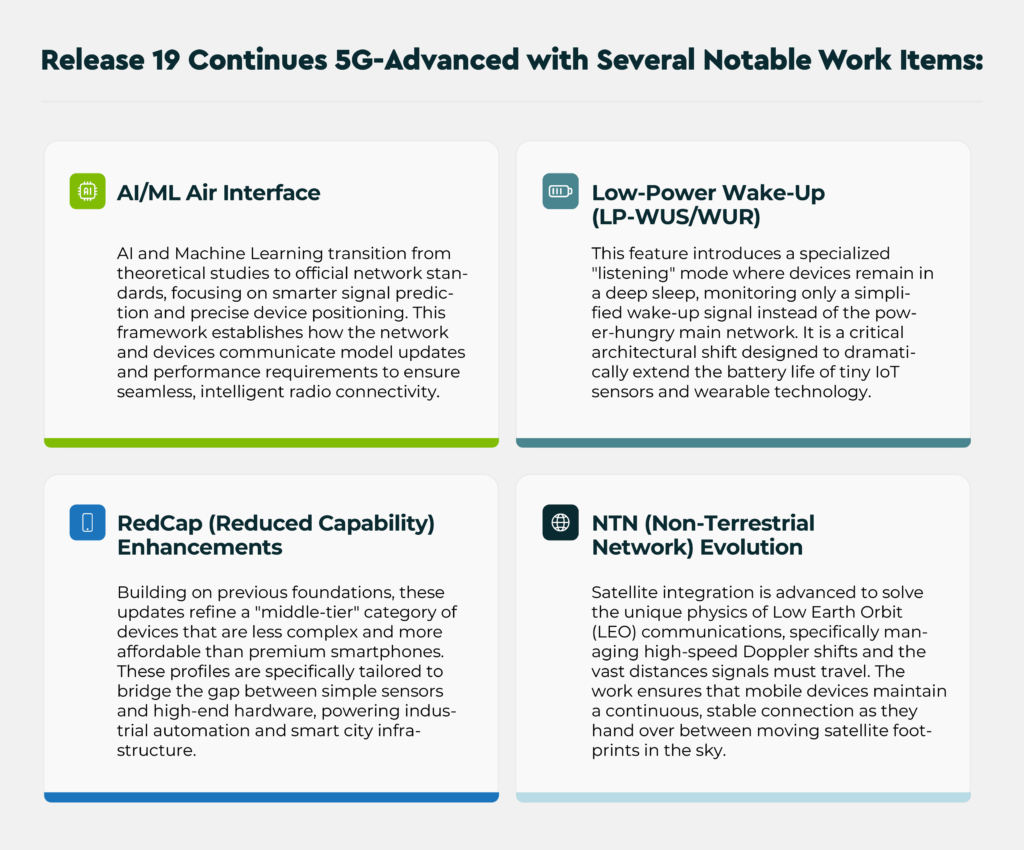
Release 19 progressed through its scheduled milestones in 2025. The functional freeze for RAN1 completed in June, with RAN2/3/4 following in September at the TSGs#109 plenary in Beijing. The code freeze followed in December at TSGs#110 in Baltimore. This follows 3GPP’s established release process—each release goes through study, work item approval, specification development, and staged freezes.
 Release 20 and 6G Studies
The 3GPP 6G Workshop held March 10-11, 2025 in Incheon, Korea brought together industry input on 6G directions. The workshop summary captured perspectives from across SA, RAN, and CT groups, with 243 submitted contributions from operators, vendors, and research organizations.
Release 20 has a dual structure: continued 5G-Advanced work (following the 18-month pattern of recent releases) alongside 6G study items. The 6G studies approved for Release 20 focus on scenarios and requirements, channel modeling for new frequency ranges, and architectural exploration. These are study items—they produce technical reports informing future work items, not normative specifications.
The 6G timeline, as currently planned: studies continue through Release 20, with normative work beginning in Release 21 (targeted for the IMT-2030 submission window). The specific Release 21 timeline will be decided no later than June 2026, when key 6G studies are complete.
Technical themes receiving study attention include: ISAC (Integrated Sensing and Communication), AI/ML-native design (building on Release 19’s initial AI/ML work), energy efficiency (both device and network side), and new spectrum utilization (including FR3, the 7-24 GHz range). How much of this becomes Day 1 6G versus later enhancements will emerge from the study phase.
For analysis of what 3GPP’s initial 6G specifications will include—and how technical requirements are being translated into work item scope—see our readout: 3GPP Starts Defining What Day 1 6G Will Actually Mean.
What to Watch in 2026
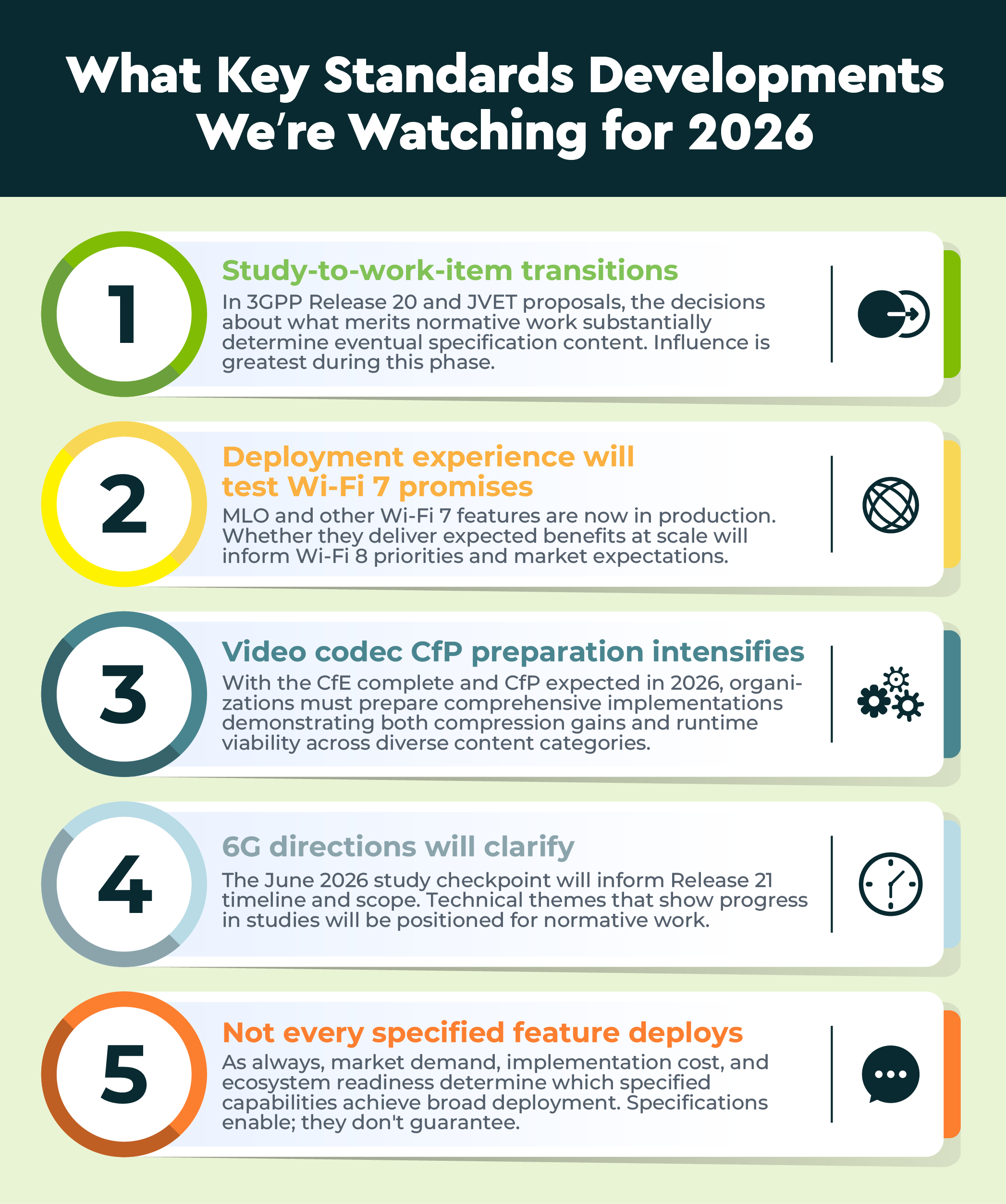
The key activity will be Release 20 study progress and the decisions about what becomes Release 21 work items. Study items that demonstrate both technical merit and implementation viability will have the strongest path to normative specification. The June 2026 checkpoint for 6G study completion will be a significant milestone—it will inform the Release 21 timeline and scope decisions.
Wi-Fi: Wi-Fi 7 Published, Wi-Fi 8 Development Continues
Wi-Fi 7 (802.11be) Publication
IEEE published 802.11be on July 22, 2025. The standard had been in development since 2019, with the Wi-Fi Alliance running certification since early 2024 based on draft specifications. Publication completes the normative definition phase.
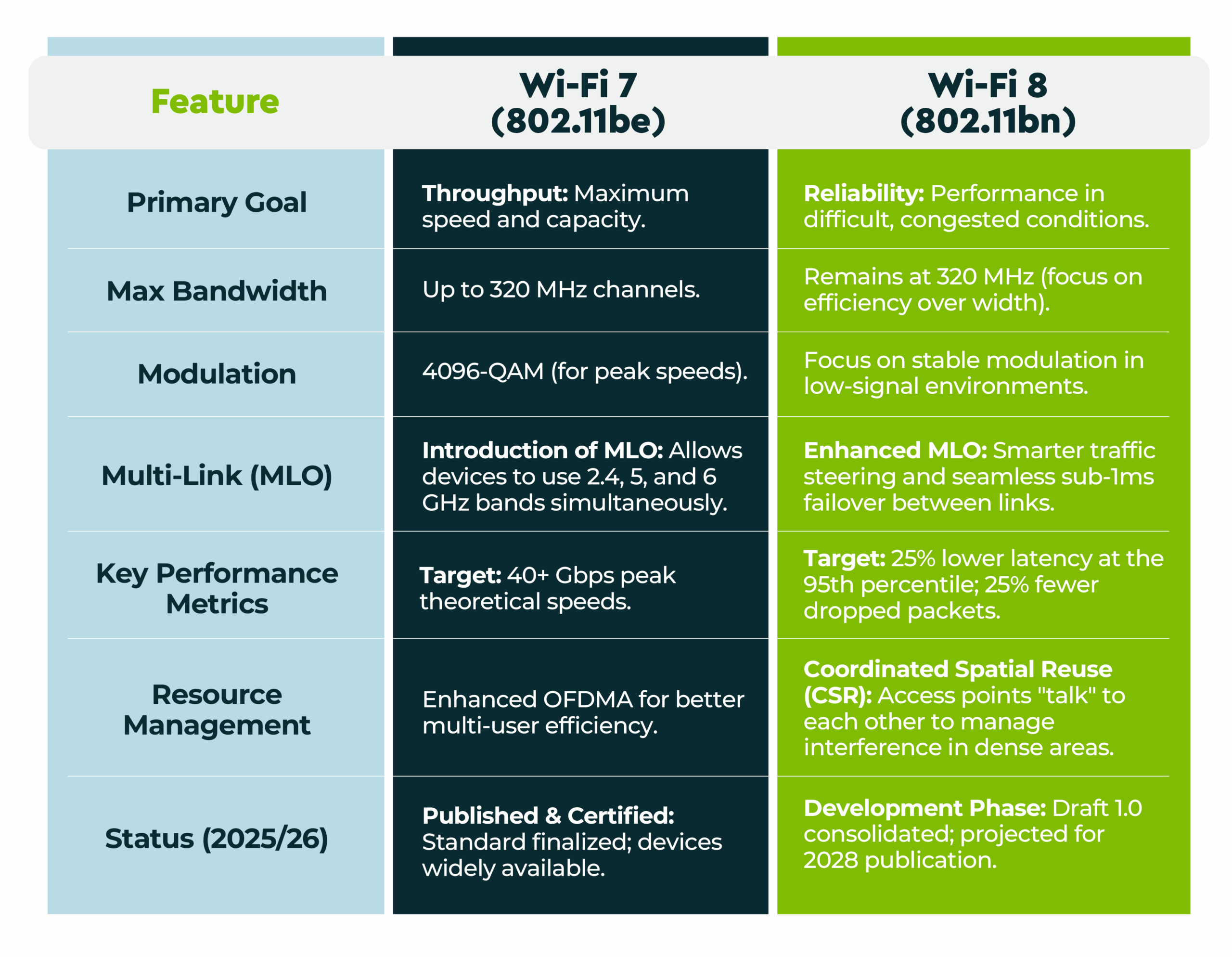
Wi-Fi 7’s major features include: MLO (Multi-Link Operation) enabling aggregation across 2.4/5/6 GHz bands; 320 MHz channel support in 6 GHz; 4096-QAM (Quadrature Amplitude Modulation); and enhanced OFDMA (Orthogonal Frequency Division Multiple Access). MLO is architecturally significant—it changes the relationship between stations and access points from single-link to multi-link, with implications for traffic management, power saving, and failure recovery.
With publication complete, focus shifts to deployment experience. Certification testing validates conformance to the specification, but real-world performance depends on implementation choices in areas the spec intentionally leaves flexible. How well MLO delivers on its promise of improved throughput and latency will become clearer as production deployments accumulate.
Wi-Fi 8 (802.11bn) Development
The 802.11bn amendment—designated UHR (Ultra High Reliability) and expected to become Wi-Fi 8—achieved an important milestone in 2025 with the consolidation of its first complete draft (D1.0). This draft represents the Task Group’s first attempt at capturing all proposed features in a unified specification document. Achieving D1.0 signifies that the scope of Wi-Fi 8 is largely defined, though substantial refinement remains.
The IEEE 802.11 Working Group reports that TGbn (Task Group bn, the group responsible for 802.11bn) has resolved approximately 700 of 8,500+ comments on D1.0, with comment resolution continuing. To put this in perspective: the comment resolution process is how IEEE 802.11 standards mature. Each comment represents technical feedback from voting members—questions about ambiguous text, proposals for alternative approaches, or identification of inconsistencies. The ratio of resolved to total comments indicates the standard is still in early refinement. Reaching final publication requires resolving substantially all comments through multiple draft iterations, which is why the standard is projected for completion around 2028.
The “Ultra High Reliability” designation reflects 802.11bn’s focus areas. According to Qualcomm’s technical analysis, the IEEE scope document targets: 25% higher throughput under challenging signal conditions, 25% lower latency at the 95th percentile, and 25% fewer dropped packets during roaming. These are tail-case metrics—focusing on performance in difficult conditions rather than peak capability.
Key 802.11bn mechanism areas:
- Multi-AP Coordination (MAPC) enables coordinated scheduling and spatial reuse across access points. Schemes include C-SR (Coordinated Spatial Reuse), C-BF (Coordinated Beamforming), and C-TDMA (Coordinated Time Division Multiple Access). These mechanisms address interference in dense deployments where overlapping BSSs (Basic Service Sets) degrade performance. MAPC was discussed during 802.11be but deferred; 802.11bn makes it a primary focus. The MAPC framework is designed to improve coexistence among Wi-Fi devices, enabling more deterministic performance in environments with many competing access points.
- Seamless Mobility Domain (SMD) addresses one of the persistent limitations of previous Wi-Fi generations: handoff performance during roaming. SMD defines a framework where multiple AP MLDs (Access Point Multi-Link Devices) operate as a single logical entity for roaming purposes. Critically, devices associate with the SMD directly rather than with each individual AP. When roaming from one AP to another within the SMD group, handover delay is significantly reduced because no new link needs to be established—although the physical connection shifts, the logical link remains anchored to the SMD. This enables context transfer (security state, sequence numbers, capabilities) with minimal disruption to latency-sensitive applications.
- Spectrum efficiency features including NPCA (Non-Primary Channel Access) and DSO (Dynamic Subband Operation) allow stations to transmit on available bandwidth when the primary channel is busy or when capabilities differ between AP and station. NPCA allows devices to transmit on available secondary channels even when the primary channel is busy, minimizing idle airtime. In enterprise settings, this leads to higher aggregate throughput and more predictable performance for dense user populations.
 Integrated Millimeter Wave (802.11bq)
2025 marked the official kickoff of IEEE 802.11bq, an amendment focusing on IMMW (Integrated Millimeter Wave) operation. The 802.11bq project addresses operation in the 42-71 GHz unlicensed bands with an integration requirement: devices must also support at least one sub-7 GHz band. This “integrated” approach treats mmWave as capacity supplementing lower-band operation, not as standalone.
The rationale comes from WiGig (802.11ad/ay) experience, where standalone 60 GHz operation faced adoption challenges due to blockage sensitivity and limited range. Unlike previous mmWave protocols, IMMW aims to significantly reduce complexity and cost by treating mmWave as an additional link integrated with traditional 2.4 GHz, 5 GHz, and 6 GHz bands. By requiring lower-band support, 802.11bq ensures devices have fallback connectivity and can use lower bands for control signaling. The task group is working toward initial specification text in 2026.
Looking Ahead in Wi-Fi
Key Wi-Fi technical focus areas for 2026 and beyond include advancing MAPC to improve spatial reuse and enable more deterministic performance in dense deployments. Another major challenge is the integration of mmWave operation with sub-7 GHz Wi-Fi, requiring seamless mobility, intelligent band steering, and efficient control-plane coordination across vastly different propagation characteristics. The use of AI and machine learning is also becoming essential to manage growing system complexity, enabling adaptive scheduling and real-time performance tuning.
What to Watch in 2026
For Wi-Fi 7: deployment experience will reveal how well MLO performs in practice. For Wi-Fi 8: MAPC specification will be the key technical focus—defining coordination protocols that work across vendors with acceptable overhead. The current progress (700 of 8,500+ comments resolved) indicates substantial work remains before the standard stabilizes, with multiple draft iterations expected before reaching final publication.
Video Compression: Beyond-VVC Exploration Begins
The Joint Call for Evidence
At its 39th meeting in July 2025, JVET issued a Joint Call for Evidence for video compression with capability beyond VVC (Versatile Video Coding, also known as H.266). The CfE requests evidence in three areas: improved compression efficiency, encoding under runtime constraints, and enhanced functionality.
The “runtime constraints” criterion is notable. Previous codec development focused primarily on rate-distortion performance—compression efficiency at a given quality level. The CfE explicitly includes implementation cost tradeoffs, recognizing that VVC’s compression gains (approximately 50% bitrate reduction versus HEVC at equivalent quality) came with substantial complexity increases. VVC encoding complexity is roughly 10x that of HEVC (High Efficiency Video Coding); decoding complexity approximately doubles. Hardware decoder availability has been slower than for previous codecs, and software decoders impose significant power consumption.
Call for Evidence Responses
According to the 152nd MPEG meeting report, five responses were received at the 40th JVET meeting in October 2025, originating from 16 companies and research labs. Twenty submitted codec configurations underwent testing, in addition to VVC anchors generated using VTM (VVC Test Model), VVC encodings with reduced runtime, and encodings using JVET’s ECM (Enhanced Compression Model) experimental software.
The evaluation included extensive subjective viewing of sequences across seven categories: SDR (Standard Dynamic Range) Random Access at UHD/4K and HD resolutions, SDR Low Bitrate HD, HDR (High Dynamic Range) Random Access at 4K and cropped 8K, Gaming Low Bitrate HD, and UGC (User-Generated Content) Random Access HD. This breadth of test content reflects the diverse application landscape that a next-generation codec must address.
After evaluation, JVET found evidence of novel technology with better compression capability, as well as capability for good performance with runtime-constrained encoding. The evaluation also identified support for functionality such as ultra-low delay and error resilience beyond the capabilities of existing video compression standards. Notably, both traditional signal processing approaches and neural network/AI-based technologies showed promise in the submissions.
Path to Call for Proposals
Based on the positive CfE results, JVET plans to work toward an open Call for Proposals (CfP) for submission of technology for a next-generation video compression standard. The CfP is expected to be issued during upcoming meeting cycles in 2026, with evaluation of proposals likely occurring in 2027. This timeline follows the pattern established during VVC development, where the CfE-to-CfP transition took several months to define evaluation criteria and logistics.
For more on the next-generation codec landscape and the competitive dynamics shaping this standardization effort, see our analysis: The Next-Generation Video Coding Race Heats Up.
Neural Compression Status
Neural network-based compression has demonstrated competitive rate-distortion performance in research settings. The question for standardization is whether neural approaches can meet deployment constraints—particularly decoder complexity for mobile devices.
Traditional codecs have asymmetric complexity: encoders (running on servers) can be sophisticated while decoders (running on devices) must be lightweight. Neural autoencoder architectures tend toward symmetric complexity. Approaches to address this include model distillation, asymmetric architecture design, and hybrid systems that use neural networks for enhancement rather than core decoding.
The CfE assessment noted that both conventional technology (based on traditional signal processing) and technology based on neural networks and artificial intelligence are considered interesting for the upcoming CfP. This suggests the next-generation codec may incorporate elements of both approaches, potentially using neural techniques where they provide clear advantages while relying on traditional methods where decoder efficiency is paramount.
What to Watch in 2026
Work towards an open Call for Proposals is expected in 2026, intensifying standardization activity. Organizations planning to participate will need to prepare comprehensive codec implementations that demonstrate both compression performance and runtime characteristics across the defined test categories. The tools that gain traction in the first 18-24 months of proposals typically define the eventual codec architecture—making 2026-2027 a critical window for influencing the next decade of video compression standards.
Looking Across Domains
While each domain has its own technical focus, some common patterns appear:
- Implementation considerations are explicit. The JVET CfE’s runtime constraints make implementation cost a stated evaluation criterion. Wi-Fi 8’s quantified reliability targets (25% improvements in specific metrics) create testable requirements. 3GPP’s 6G discussions include references to avoiding the complexity accumulation that characterized 5G. These aren’t new concerns—implementation viability has always mattered—but they’re receiving explicit attention in 2025-era work.
- Tail-case performance gets attention. Wi-Fi 8’s focus on 95th-percentile latency and performance under challenging conditions; video codec evaluation including constrained-runtime scenarios; 3GPP energy efficiency work treating power budgets as constraints rather than optimization targets. Real deployments encounter adverse conditions, and specifications increasingly acknowledge this.
- AI/ML integration is maturing. 3GPP Release 19 AI/ML work moves from study to specification. JVET considers neural compression approaches. The questions have shifted from “can ML help?” to “how do we specify, test, and deploy ML-based features?”
Ofinno’s Standards Activity
Ofinno expanded formal 3GPP participation in 2025, increasing engagement across multiple working groups. This participation generates both standards contributions and invention opportunities—the same technical work supports both activities, with portfolio strategy informing contribution priorities.
In Wi-Fi, Ofinno researchers serve as voting members of the IEEE 802.11 Working Group and delegates in Task Groups bf and bn (TGbf and TGbn). The achievement of Wi-Fi 8’s first complete draft was possible in part through the pivotal work and collaboration of Ofinno engineers developing new mechanisms for MAPC coordination, seamless roaming protocols, and spectral efficiency enhancements. In the 802.11bq mmW ave effort, Ofinno has focused on developing solutions to streamline mmWave operation, proposing management and control mechanisms that leverage the cross-link capabilities of IMMW stations.
The video team increased contribution acceptance rates through investment in methodology alongside algorithm development. Understanding the evaluation framework, reference software architecture, and how to communicate complexity tradeoffs clearly proved as important as the underlying technical innovations.
For 2026, Ofinno’s research is positioned to address emerging challenges holistically—combining cross-layer design, data-driven intelligence, and scalable architectures aligned with the evolving standards landscape across cellular, Wi-Fi, and video compression.
Conclusion
2025 brought progress across cellular, Wi-Fi, and video compression standards—Release 19 frozen, Wi-Fi 7 published, an open Call for Proposals for a beyond-VVC compression standard launched with positive CfE results. These are meaningful milestones in ongoing programs. Standards work proceeds incrementally, with each release building on prior work.
The 2026 agenda is clear: 6G studies continue toward work item decisions; Wi-Fi 8 specification advances through comment resolution; video codec Call for Proposals work initiated. Organizations active in these processes will shape the specifications that enable products and services for the next decade.
For ongoing analysis of standards developments and other insights into the future of connectivity, follow Ofinno on LinkedIn and read our blog.
