


Key Takeaways
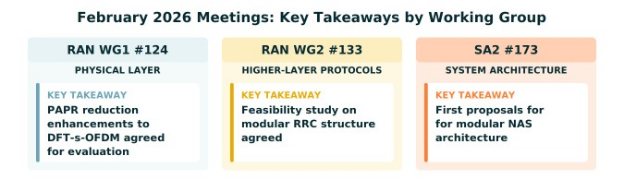
- RAN WG1 agrees on candidate techniques for 6G uplink PAPR reduction — The group finalized the list of PAPR reduction enhancements to DFT-s-OFDM that will advance to evaluation, including FDSS variants, spectrum extension/truncation, and AI/ML-based approaches. These techniques target uplink coverage extension at the 7 GHz band critical to 6G deployment, and the results from the upcoming evaluation phase will shape the 6G physical layer design.
- RAN WG2 launches feasibility study on modular RRC structure — After two meetings of documenting 5G RRC configuration pain points, the group agreed to formally study modular RRC structure — the most concrete action yet on reducing signaling complexity, improving delta signaling reliability, and supporting cleaner inter-node mobility in 6G.
- SA2 tables first 6G system architecture proposals — Companies brought specific proposals for key issues including Slicing, QoS, AI, Computing, Interworking and Migration architecture design in 6G, and modular NAS design and distributed control plane signaling, moving beyond problem identification to explore how 6G can address the AMF signaling concentration issues present in 5G.
Overview
3GPP’s RAN WG1 and RAN WG2 met in Gothenburg, Sweden, while the SA working groups met concurrently in Goa, India — both running February 9–13, 2026, for their respective 124th, 133rd, and 173rd sessions. These meetings arrived at a transition point: Release 19 was formally closed with ASN.1 frozen after RAN plenary #110, and the Release 20 Study on 6G Radio — now in its third meeting since launching in August 2025 — shifted into a higher gear.
The 6G study targets completion by May 2027, placing the work at roughly the quarter-mark. The RAN plenary’s working principle for 6G — calling for “lean and streamlined standards” that avoid the proliferation of options and configurations that burdened 5G — was reaffirmed at the opening and set the tone for the week.
The defining characteristic of these February meetings was a shift from problem identification to solution-oriented discussion. Previous sessions focused on documenting 5G limitations and scoping which issues 6G should address. This time, companies brought specific architectural and technical proposals, the groups began reaching agreements, and evaluation frameworks were established. Across all three working groups, the 6G study moved from asking “what needs fixing” to debating “how should we build this.”
This readout covers the headline development from each working group: the waveform evaluation framework taking shape in RAN WG1, the protocol architecture decisions advancing in RAN WG2, and the first system architecture proposals surfacing in SA2.
RAN WG1: The Waveform Candidates for 6G Uplink Coverage
Uplink coverage — the ability of a device to maintain a reliable connection back to the base station — has been a limiting factor in every generation of cellular technology. For 6G, the challenge intensifies around the 7 GHz band, which is expected to serve as a key deployment band. At these frequencies, path loss is higher than in the sub-6 GHz bands used by most 5G deployments, making uplink power efficiency critical. A device that cannot meet the uplink link budget requirement around 7 GHz either loses coverage or forces operators to densify their networks.
The central physical layer parameter in this equation is Peak-to-Average Power Ratio (PAPR). High PAPR forces the device’s power amplifier to operate with significant backoff to avoid signal distortion, reducing effective transmit power and coverage range. Lowering PAPR allows the amplifier to operate closer to saturation, improving effective radiated power and extending coverage without fundamental changes to device hardware or network density. The impact is concrete: lower PAPR translates to wider coverage per cell site, better cell-edge reliability, and improved power amplifier efficiency.
This is why the Gothenburg waveform discussion carried weight beyond the physical layer community. After extensive deliberation across multiple sessions during the week, RAN WG1 agreed on the full list of candidate PAPR reduction enhancements to DFT-s-OFDM that will advance to evaluation — effectively setting the starting field for one of the most consequential technical competitions in the 6G standard. The agreement, captured in the Feature Lead’s summary (R1-2600789), also established that 5G NR Release-15 DFT-s-OFDM will serve as the baseline reference against which all proposals are measured.
The candidates fall into two broad categories. The first is conventional signal processing built around Frequency Domain Spectrum Shaping (FDSS), a technique that reshapes the transmitted signal’s spectral characteristics to boost power by lowering signal peak in the time domain. The agreed list includes baseline FDSS, FDSS with spectrum extension (using additional bandwidth to smooth the signal envelope), FDSS with spectrum truncation for π/2 BPSK, tone reservation, GMSK-approximation-based FDSS, and several modulation-based variants using offset-QAM and π/2-PAM. These are built on methods with established analytical foundations — the question is how much additional PAPR reduction they can deliver beyond the NR baseline.
The second category is AI/ML-based waveform optimization. This was the more contested inclusion. Samsung and vivo were prominent advocates, while Qualcomm and others favored concentrating on conventional signal-processing techniques. Rather than resolving the debate in Gothenburg, the group included both categories on the agreed list, effectively deferring the question to the evaluation phase. Companies will bring simulation results to the April interim, where performance data against the NR baseline will begin narrowing the field. The group also designated multi-rank uplink MIMO for DFT-s-OFDM as a high-priority study item, addressing whether 6G devices can achieve rank-2 or higher uplink transmission with this waveform.
Beyond the waveform work, RAN WG1 established the evaluation framework for 6G Non-Terrestrial Networks (NTN), agreeing on frequency band and satellite orbit combinations for study and adopting the principle that terrestrial-network performance is prioritized when designing common TN/NTN solutions. The group also agreed on detailed energy efficiency evaluation models — including base station sleep state transition parameters and UE power consumption scaling factors — providing the measurement infrastructure needed for the evaluation phase ahead.
RAN WG2: Modular RRC and the Path to a Cleaner Protocol Architecture
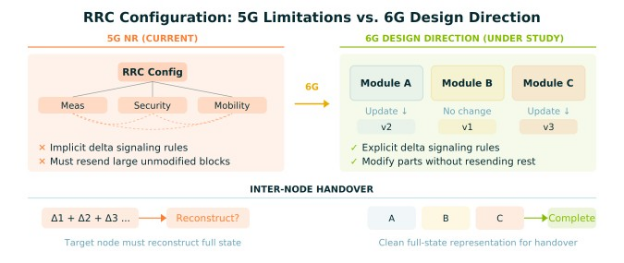
RRC — Radio Resource Control — is the protocol through which base stations configure UE behavior: measurement parameters, security settings, mobility thresholds, and resource allocations. Over five releases of 5G development, the RRC configuration has grown into a deeply nested ASN.1 structure with complex interdependencies that create well-documented problems. Delta signaling — the mechanism for sending partial configuration updates rather than full configurations — relies on implicit rules that are ambiguous enough to cause interoperability issues. When a UE undergoes inter-node handover, the target node must reconstruct the UE’s complete configuration from a series of incremental updates it never saw. And when the network needs to modify one parameter, the encoding structure often forces it to retransmit large unmodified configuration blocks alongside the change, increasing signaling overhead. Modular RRC represents a shift from a “one-size-fits-all” design to a modular, flexible, and customized design that adapts to diverse service requirements.
These issues have been discussed since the 6G study began, with broad consensus that the 5G approach cannot scale without added complexity. But for two meetings, the group remained in diagnostic mode — analyzing pain points and building the case for change without committing to a direction. Gothenburg was where the transition happened.
RAN WG2 agreed to perform a feasibility study on modular RRC structure — the most concrete step yet toward addressing this challenge. The specific agreements map directly to the documented problems. On delta signaling: investigate how to make update rules explicit within the signaling structure itself, reducing reliance on implementation-specific interpretation. On configuration overhead: ensure the network can modify individual configuration components without resending large unmodified blocks. On mobility: ensure the structure can represent a UE’s entire current state — assembled from potentially many incremental updates — for clean handover to a new node. Post-meeting email discussions were established on both the underlying ASN.1 encoding and the higher-level modular design, with the expectation that the April meeting will produce architectural proposals rather than additional problem analysis.
The modular RRC feasibility study was the headline, but RAN WG2’s 6G work advanced across several other fronts as well. On mobility, the group documented how 5G handover procedures have become fragmented — Conditional Handover, L1/L2 Triggered Mobility, and conventional handover solving overlapping problems through different mechanisms across different protocol layers — establishing an explicit set of design constraints for the 6G mobility framework. The group is working under the RAN plenary’s direction to focus on standalone 6G architecture until at least September 2026, targeting a single unified approach. On MAC layer security, the group agreed that BSR, DSR, and PHR are “time-critical” MAC CEs that must be sent before security establishment — a constraint that will directly shape how MAC security is implemented in 6G and that the group will take to a joint session with SA WG3 in April. And on traffic modeling, RAN WG2 confirmed that mobile AI traffic is uplink-dominant, bursty, and latency-sensitive, establishing baseline characteristics that will inform scheduling and buffer management protocol design.
SA2: First Proposals for Distributed 6G Core Network Signaling
SA2 defines how the core network is organized — the functions that handle registration, session management, authentication, and network-level mobility above the radio interface. At its February session, the group held its first 6G discussion where companies moved beyond identifying architectural limitations to proposing specific solutions.
The focus was on NAS (Non-Access Stratum) signaling — the control plane messaging between UEs and the core network. In 5G, NAS signaling is concentrated in the AMF (Access and Mobility Management Function), which serves as the central control point for access and mobility management. As networks have scaled and the range of supported services has expanded, this centralized design has created signaling concentration that limits flexibility for new operator services and deployment models.
The proposals explored modular NAS architecture and distributed routing functionality for control signaling, aiming for a more extensible control plane that can accommodate the breadth of 6G use cases — from massive IoT to real-time AI services to integrated terrestrial-satellite operation. High-level design principles were discussed, including approaches to reducing AMF signaling concentration and better supporting service differentiation.
No architectural decisions were finalized — the SA2 work is in its early solution-exploration phase — but the meeting provided initial visibility into which directions have industry support and which face resistance. That early signal is significant: as the RAN groups demonstrated this same week, the window between “first proposals” and “agreed direction” can close quickly once the group shifts into solution mode.
What’s Next
The next milestone is the RAN WG1 #124bis and RAN WG2 #133bis interim meetings in April.
- Waveform evaluation results arrive. Companies will bring simulation results comparing the agreed PAPR reduction enhancements against the NR Release 15 DFT-s-OFDM baseline. This data will begin narrowing the candidate list — and will be the first test of whether AI/ML-based approaches can demonstrate gains competitive with conventional signal processing.
- Modular RRC moves from feasibility to architecture. The post-meeting email discussions on ASN.1 encoding and modular structure are expected to produce concrete design proposals for the April session, moving beyond the problem-documentation phase.
- SA2 architecture proposals face their first convergence test. The initial proposals for modular NAS and distributed control plane signaling will be refined, and the group will begin testing whether the directions tabled in February can attract the majority support needed to move from exploration to agreed study conclusions.
The 6G study is at its quarter-mark with a May 2027 target. The February meetings laid evaluation frameworks and launched feasibility studies — but the hardest phase, where competing proposals must be narrowed and real trade-offs made, is just beginning.